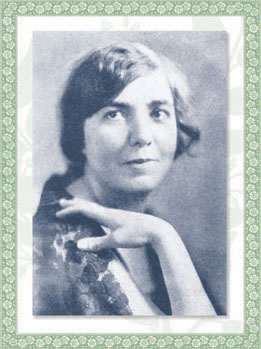
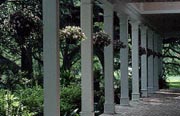
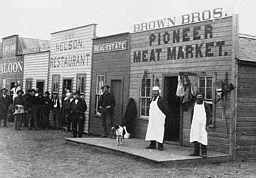
During the years of her early childhood, Lee showed a
remarkable taste for and interest in poetry, drama, and all types
of literature rarely relished by children. This passion of hers
was encouraged especially by her mother, who had published poems
occasionally in her own youth. Not surprisingly, from the time Muna could write, she composed verses.
In 1902, enticed by business opportunity, her father boldly moved the family to what became
Hugo, Oklahoma, then part of Indian Territory (now the county
seat of Choctaw County, in the southeastern corner of the state),
with its vast, open expanses of land. Oklahoma was then the home of more
Native Americans than any other state in the country. The state's name
was derived from two Choctaw words, okla, meaning
"people," and humma, meaning "red":
the
Chickasaw, Choctaw, Seminole, Cherokee and Creek; Cheyenne and
Arapaho; Kiowa (Apache, Comanche, Kiowa, Wichita, Waco, Tawkoni,
Caddo, Kichai and Delaware); Pawnee (Pawnee, Ponca, Nez Perce,
Ottawa, Confederated Peoria, Quapaw, Seneca, Eastern Shawnee and
Wyandot); and Sac- and Fox-Shawnee. Living in Hugo, she would see Choctaws in town every day.
The year the Lees arrived was the year the St. Louis–San
Francisco Railway built an east-west line from Hope, Arkansas, to
Ardmore, Oklahoma, creating the territorial town — "a straggling town of tents" — later named Hugo
(after the French novelist, whom a local surveyor's wife
admired). Almost overnight with the completion of these two
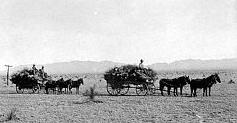
strategic rail lines, Conestoga wagons converged on the
new territory. The town's rail depot was the center of attention
with trains coming and going all day long. The Harvey House
Restaurant in the depot grew in popularity. There were dance-hall girls, hustlers, and gunfighters. And the "Harvey Girls" — the women who worked as waitresses in the Harvey
House — who greeted each train that arrived.
In contrast were the prairie flowers — great billowing masses of
color and fragrance — that enchanted her (and that later
would help give a distinctive character to her poetry: meadow-sweet, spiderwort, johnny-jump-up,
foxglove, lavender, and columbine, among others). There was the never-ending
fascination in her father's drugstore, where long rows of blue glass jars were
filled with strange substances — such as "linden leaves in dried bunches
with tiny flowers still clinging to the stem" — labeled in abbreviated Latin which suggested to her the world
beyond the prairie. And it was there in her father's store that
Lee would take fiction from the rack of books and magazines, go curl up inside an
empty packing-case, and read for hours — "anything," she said, "literally thousands of
books": George Eliot, Victor Hugo, Charlotte M. Braeme, G. A. Henty, Sir
Arthur Conan Doyle, Alexandre Dumas, and numerous other popular authors.
Not only was Lee's childhood filled with literature, but with
politics as well. Her father, who was an ardent Democrat and
served as a member of the 1907 Oklahoma Constitutional Convention,
often held political gatherings in a room above the store. Politics
was a much-discussed subject in her family, and what she absorbed also contributed to
the development of her intellect, preparing her for her future political life.
Her experience in Oklahoma no doubt helped take her beyond
the bounds of conventional Southern femininity, and opened her
eyes to new possibilities of womanhood. It nurtured her
independent spirit, as surely did word of the time's reawakened
suffrage movement.
In 1909, at the age of fourteen, Lee returned to Mississippi
for a year to attend Blue Mountain College, her mother's alma
mater, a small privately-owned liberal arts college for women.
Already unconventional and indifferent to schoolgirl activities,
she spent much of her time with her English teacher, David
Guyton, reading Browning and discussing Plato on the porch of her
maternal grandfather, known as Dr. Mac Williams (who knew
Faulkner's family). Guyton, himself a poet and blind as Homer,
encouraged Lee to write, and soon she was bringing him large
numbers of poems she had secretly written, amid her studies of
English literature, Latin, French, physics, chemistry, and
botany.
Guyton later recounted that "most of her college-day verses
were amateur in type, but there were hints and flashes of genius
even in those early attempts at writing." He also noted that "Robert Browning
was her breath of life even in her early teens; she read him then with the skill and
sympathetic understanding of a master."
Browning, who believed that
the incarnation of divine love was
necessary to guide human love, and that art was rooted in the
ethical nature of human beings, gave her a model of religious and
artistic convictions. He brought Christian beliefs to the test of
experience, discarding orthodox dogma such as original sin, and
gave her the idea that men and women cannot be judged merely by their
acts, but by their quality of character fashioned in the act of living.
In stressing the importance of intellect in moral affairs, he defined
for her the approach to life that she would follow. Furthermore,
his earliest published verse exhibited the poet's most private
feelings, as her own lyrics would do as well.
In June 1910, Lee returned to Oklahoma to live at home in Hugo and
then help her family move to Oklahoma City, the capital
of the new "Sooner" state. Originally settled in a single day in
the Great Land Run of '89, Oklahoma City had become a thriving commercial
center with new oil-money flowing like adrenalin and stimulating its
development. It offered her family a relatively richer life
compared with their frontier life in Hugo. Just eighteen miles south of the city
was the young University of Oklahoma, in Norman, where Lee
enrolled in the fall of 1911.
After a full year including summer school there,
during which she fell in love for the first time, she returned
again to Mississippi, and entered the University of Mississippi from
which she graduated with a BS in June 1913, at the age of eighteen. Little
is recorded about her year at Ole Miss, where she took classes in English
literature, Italian, history, mathematics, psychology, and geology. The
school's yearbook has only a couple of sentences beneath her name which identify
her as "fraught with learning […] a person with brains. We are glad that
she came to us in time for Ole Miss to claim her as one of her daughters."
After her graduation, Lee returned to Oklahoma. Her career
ambition at the time was to be a schoolteacher, that traditional
job of educated single women. She started her first position in
September 1913, teaching third grade (for $50 a month) in the public
elementary school of Sulphur, Oklahoma, in the hilly south-central
part of the state. For the first time she was living on her own,
working with children during the day, and working with words at
night to express herself in verse. She would soon start submitting her poems
to a variety of literary magazines.
During the summer after that school year in Sulphur, Lee
returned to the University of Oklahoma to take graduate courses in
English literature and education. She had accepted a better
teaching position at Mission High School in Mission, Texas — in
the southern tip of Texas, a region called the Rio Grande Valley.
It was a small town originally founded by the Oblate Fathers who
had built a mission there in the early nineteenth century. When
Lee was there, it was not much more than a railroad stop, with the
recent advent of the Missouri Pacific Railroad. She taught classes
in English literature and grammar, composition, and rhetoric, as
well as four courses in Latin.
Although she had obtained a Texas teaching license, she moved
back to Oklahoma the following year to teach high school in Lawton,
in the southwestern corner of the state, by Fort Sill where
Geronimo had been held prisoner just a few years before (his grave
lies close to Lawton). The town itself had been founded at the
turn of the century when the Kiowa-Comanche reservation was opened
for white settlement, and it was growing rapidly with the influx of
settlers. Lee's new teaching job not only gave her a better salary
($85 a month, compared with $75), it enabled her to be closer to
her family in Oklahoma City. At
Lawton High School she taught classes in English literature and in
composition and rhetoric.
The poems focus on her personal experience with love lost. Composed in the
aftermath of her first great love involving a young poet
named John ("Jack")
McClure, whom she had met
at the University of Oklahoma, they express her pain and sorrow, anger and
regret. Like most of her poetry, they are short subjective poems in the lyric tradition — poems with a song-like outburst of her innermost thoughts and feelings:
I shall not sing of love —
I weary of the old unrest.
(But like a hangman, love has burned
His crimson emblem on my breast;
But, like a hangman, love has set
A crimson scar my heart above.)
Yea, I am wearied with old pain —
I shall not sing again of love. |
The sequence of "Footnotes" ends on an ambivalent note of
recovery, which shows the conflict of inner forces that persisted
in her for years:
Now have I conquered that which made me sad
—
The bitterness and anguish and regret.
Yea, I have conquered it. And yet — and yet —
The moaning of the doves will drive me
mad. |
This initial publication of Lee's in Poetry was soon
followed by others in this influential magazine from Chicago.
During this period, she would spend a summer there to work in
its office, and strengthen her relationship with it (subsequently,
the salutation of her correspondence with Poetry's
founding editor, Harriet Monroe, was "Dear Aunt Harriet," since
Monroe, not a blood relative, had become her patroness and thus "poetry aunt"). The time
in which Lee was starting to gain recognition for her verse
happened to be a good one. Indeed, the founding of Poetry in 1912
had heralded a great revival of interest in poetry throughout
America, and poets and poetry abounded everywhere.
Nineteen sixteen was Lee's debut year as a poet, for that year she entered
the world of publishing with multiple publications in a variety of
literary magazines.
Also in January, she published in Smart Set the
first of several lyrics, most written about her great love of the
time, to appear in this self-proclaimed "Magazine for the Civilized
Minority." It was one of her so-called love songs, "The Unforgotten":
I can forget so much at will:
That first walk in the snow,
The violet bed by the April rill,
The song we both loved so;
Even the rapture of Love's perfect hour.
Even the anguish of Love's disdain —
But never, but never, the little white flower
We found one day in the rain. |
In the February issue she published another short lyric,
"Bereavement," and in the April issue she published "Arcady," which
to her joy was featured on that issue's opening page:
It was such April weather
As a lover never forgets,
When I and my love roamed together
Looking for violets.
The breeze laughed straight in our faces,
And joy laughed straight from our hearts,
While grasses lisped in the marshy places
Where the johnny-jump-up starts.
[. . . . . . . . . . . . . . . . . . . . . . . . . . . .]
And the violets were joy in plenty,
With the dark, cool leaves between,
To my love, who was not twenty,
And me, who was just seventeen. |
Alluding to her early days in Oklahoma City, where she had
found by the streams and in the hills outside of town a bucolic world suited to
her romantic passions, she translated the classical Greek Arcadia
into the landscape of the American Southwest. By using images of the nature around her,
instead of importing them from abroad, she had found a way to be original with an American
voice, and thus enhance the appeal of her poetry.

Published in New York, Smart Set at this time was featuring the brilliant
criticism of H. L.
Mencken (who in 1914 had joined George Jean Nathan as the magazine's co-editor);
his bold ideas were helping to clear the way for the tremendous flowering of new
writing in America, to which Lee would contribute in the decades to come. And
the magazine was gathering laurels for its poetry. For the young schoolteacher, the
excitement of her initial publications in Poetry and Smart Set, which
both had wide circulations here and abroad, was nothing less than inspirational, and
helped motivate her to keep writing verse for her new-found audience. Moreover, through her correspondence with Mencken, she had found in him a long-time mentor and
stimulating force. His generous praise of what she had already produced — and what she would later call
his "contagious belief" in her ability to keep producing good work — spurred her continued poetic development.
Later in the spring of 1916, Lee published a sequence
of seven short lyrics in the combined May-June issue of Others:
A Magazine of the New Verse from Grantwood, New Jersey, just
outside New York. This new modernist magazine, launched in 1915, was edited
by Alfred Kreymborg (his friend and fellow poet, William Carlos Williams,
would be guest editor
of the magazine's next issue, and subsequently an associate editor). Lee's verses in Others
had no titles and were simply numbered. Again, they focus on her
experience with love and its loss, as in epigrammatic number III:
Do not chafe at your bonds, dear.
It is only my heart that holds you;
That is easily broken. |
And number VI, which presents an image of her loneliness in the separation she endured:
In our town
There are painted wooden houses, one dusty park,
and I.
We grow more faded each year,
More hopeless,
More alike —
The houses, the park, and I. |
Others had been created, in Kreymborg's words, "to print the work of men and women
who were trying themselves in the new forms." He thus welcomed Lee's
experiment with free verse. She later polished four of the seven lyrics,
and presented them under the title "Imprisoned."
In July 1916, she published "A Villanelle of
Forgetfulness" in Contemporary Verse from Philadelphia,
another new poetry magazine, which first appeared in January. With
the flourish of her publications that year, which paralleled
the appearance of new journals devoted to poetry, Lee was
establishing her identity as a poet, while still struggling
with the daily realities of her life in the Southwest.
When an even better teaching job was offered her for the
next school year — to teach at a young junior college called University
Preparatory School (now Northern Oklahoma College), in Tonkawa,
Oklahoma, in the north-central part of the state — Lee gathered
her books and moved herself once more. Another small town on the
plains but not far from the capital city, Tonkawa had sprung up
after the historic land run of the late nineteenth century. The
school had been created by an act of the legislative assembly of
the Oklahoma Territory. Again, Lee would be teaching English literature
as well as composition and rhetoric, but the young men and women in
her classes would be relatively more sophisticated than the children
she previously had taught.
In August 1916 in Smart Set, Lee published a brief
statement in prose titled "Like a Tale of Old Romance," which served as an
explanatory note seemingly taken from her correspondence with the
editors:
| In all things my story has been
like a tale of old romance. First love in April weather. Kisses
snatched in fear of impending disaster. Midsummer madness and
madness of twenty years. Heart-breaking farewells. Gray cities.
Wild love-songs from over sea. Tears. Bitter immutability of
time. Quarrels. Reconciliations. Dragons, jousts, and gaping
wounds. In all things my story has been like a tale of old romance
[…] except the happy ending. |
This statement in itself, along with the series of poems Lee
published in Smart Set starting in 1916, perfectly reflects
the magazine's editorial policy: "Our stories need not strive to
point a bourgeois moral [… and] there must not necessarily be a
happy ending, for the great moving stories of life often end in
disaster."
Although the story of Lee's first love had ended in disaster for her, the growing success that she was enjoying as a poet became a certain salvation. In the fall of 1916, while teaching in Tonkawa, she won Poetry magazine's first Lyric Prize. The monetary prize was $100, and equalled a month's pay for her at University Prep. But more important to her than that, she now was not only a published poet, but a prize-winning poet.
The poetry that she was writing in the Southwest shows the
influence of the prevailing mode of love lyrics, as well as her relationship with McClure.
His manner of heartfire was much inspired by the lyric style of the Elizabethan poet,
Thomas Campion, whose
airs McClure always had in his pocket during the days of their romance.
The verses of the two Oklahomans were often part of a dialogue between them.
Her poems written then were
simple lyrics done mostly in rhymed quatrains, with occasional experiments with free verse; and the
point of view was decidedly feminine. Nonetheless, when she would depart
from the fragile voice and the predictable sentiment — a feminist
departure that would grow in force in her mature work — her poetry would demonstrate that strength and daring that life in the
Southwest demanded of her.
In
"Compensation,"
published in Poetry in August 1917,
Lee again focuses on her heart's misfortune, but with a strong-willed song to her metaphorically "dead" lover, which opens:
I shall not grieve that you are dead.
I sing to you when the stars hang low;
And though I sang till dawn were red,
You still must hear, you could not go. |
A few years later she would revise this lyric, toughening it
with a new opening (and closing) line, "I am so glad that you are dead,"
which she then used as the poem's new title. She also deleted the
original third quatrain:
Ah, once you wandered far and long.
And left me waiting hopeless here.
Though I sent you my breaking heart in a song,
You were too far — you could not hear. |
These early lines, subsequently abandoned, reveal the lingering
grief that still burdened her in Oklahoma. Life was testing her,
toughening her, and compelling her to draw on her inner
strength.
 Adding to her personal dilemma, Lee's promising teaching career
was cut short when the Oklahoma governor temporarily closed down
the junior college. Unable to secure another teaching job on short
notice, the question of what to do next confronted her like a dust
cloud. She then fell back on her family, returning to her parents' home,
and she started to work in the retail cooperative grocery for
farmers — the Southwestern Commercial Company — which her ever-enterprising
father had organized and managed; he had been forced
to abandon his pharmacy business for lack of the formal education
required for a state license. This job gave Muna room and board,
but no income. She took charge of the store,
acting as cashier, handling correspondence, and ordering from
wholesalers. After work, exhausted by the day's business, she
might spend a little precious time with poetry.
Adding to her personal dilemma, Lee's promising teaching career
was cut short when the Oklahoma governor temporarily closed down
the junior college. Unable to secure another teaching job on short
notice, the question of what to do next confronted her like a dust
cloud. She then fell back on her family, returning to her parents' home,
and she started to work in the retail cooperative grocery for
farmers — the Southwestern Commercial Company — which her ever-enterprising
father had organized and managed; he had been forced
to abandon his pharmacy business for lack of the formal education
required for a state license. This job gave Muna room and board,
but no income. She took charge of the store,
acting as cashier, handling correspondence, and ordering from
wholesalers. After work, exhausted by the day's business, she
might spend a little precious time with poetry.
The year was 1917. At twenty-two, there she was with her
intellectual brilliance and literary aspirations in Oklahoma City, amid
the sultry plains, working in a lonely grocery store and living at home
with her parents and young siblings. All the while, as always, she was devouring
literature, including the work of contemporary poets. It would
take her to a better place. Reading the monthly issues of
Poetry, Smart Set, and Others to which she subscribed, she heard the worldly voices
of Modernism calling to her.
Isolated and stifled, Lee needed to change her life. She wanted
so much more for herself — for her intellect and her ambitions.
When the opportunity to work with her
linguistic skills presented itself to her in the spring of 1918,
she pursued it with all her vigor. She applied for a federal job
to serve as a translator,
and she landed a position as "confidential translator" for the U.S.
Secret Service,
specifically, the Postal Censorship Division. With Germany's
aggressive use of espionage during the First World War that now was in its
fourth bloody year, the U.S.
government felt compelled to impose itself on the
free flow of international mail.
Lee's work would involve translating and censoring mail written
in Spanish, Portuguese and French. She had qualified for this
civil-service job, she said, by teaching herself Spanish in two
weeks. Her solid foundation in the Romance languages, together
with her burning desire to improve her situation, made this
possible.
Lee had originally expected an assignment in border service. To her surprise, though,
she was assigned to work in New York City, where a new life awaited her.
The prospect of living in New York appealed to her very much.
She was drawn from the plains and isolation of Oklahoma
to New York's cosmopolitan and intellectual excitement, like a
hungry flower to the sun. It was there that she would soon find
the community she needed to flourish as a writer and woman of
ideas.
 In the World of New York
Arriving in Grand Central Station with its bustling multitude of
people and its ecstatic high ceilings, Lee was captivated by the
energy of New York. She had never seen such a great metropolis. Fifth
Avenue seemed like a royal carpet rolled out just for her.
She boarded in the home of a woman named Gabriela Delgado, on West 72nd
Street, close to Central Park. Working
downtown on Washington Street, she felt at home among the Bohemian artists
and writers of Greenwich Village, whom she was meeting; and, as an
extension of her work with Spanish, she was developing a keen
interest in the Pan-American movement, of which she was
destined to become a distinguished leader.
Initiated by the United States in the late 1880s for largely
commercial and political reasons,
this movement aimed (in theory) at mutually beneficial cooperation,
and had stimulated an interest in cultural
relations between the Americas.
During the First World War,
when much of the business of the Pan American Union,
established in Washington in 1890,
was put on hold,
translations of poetry — English
renderings of South American voices,
and Spanish of North American ones — enjoyed a certain
popularity in books and magazines.
Lee had already gained a reputation as a talented new poet. Two dozen
of her poems had appeared in Smart Set by the time she arrived
in New York, and while there she continued to publish her "love songs" in it;
in fact, during this period, she was the magazine's second-most-frequent
contributor of verse, second only to John McClure.
Following the Lyric Prize, her "Songs of Many Moods," a sequence of
five poems, had been published in Poetry in 1917.
The debut (and only) issue of Pan American Poetry, published in February 1918, included the closing quatrain
of her "Footnotes" in both English and Spanish, under the title "The Moaning of the Doves."
The Spanish translation, titled "La queja de los nidos," was made by Nicaraguan poet Salomón de la Selva, editor in chief of the magazine, whom she had met through Harriet Monroe the previous fall in Chicago. (He claims in a letter to Edna St. Vincent Millay that he fell "quite desperately" in love with Lee and, in a letter to Jessie B. Rittenhouse, that they had even been engaged to be married.)
In July 1918, the month after she started her government job, two of
her poems appeared in the Pan-American Magazine, along with
Spanish translations of them, also by de la Selva: a love poem,
"When We Shall Be Dust," and a related lyric from her "Footnotes" titled
"I Who Had Sought God," which depicts her sense of being abandoned and thrust upon herself to survive, with only "the heart of the yellow flower with the
scent / of citrus clinging to its pointed leaf" to turn to for
comfort in her grief.
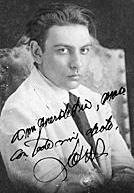
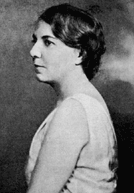 Lee's publications in these magazines
would change her life dramatically, for they brought her work to the
attention of Luis Muñoz Marín, a poet and journalist at the time (and
future governor of Puerto Rico) — the son of Luis Muñoz Rivera,
the most prominent Puerto Rican statesman of his time, a leader of the movement for political autonomy from Spain,
a journalist and poet and founder of the opposition newspaper, La democracia.
In February of the following year, the dashing young Muñoz (three years her junior) presented
himself to Lee, carrying a sheaf of her poems that he had
translated into Spanish with the hope of publishing them in his new — but short-lived —
bilingual magazine "devoted to Pan-American culture," called Revista de Indias (Indies Review).
[See "Points of Fire," a short work of fiction based on the true story of their romance.]
Lee's publications in these magazines
would change her life dramatically, for they brought her work to the
attention of Luis Muñoz Marín, a poet and journalist at the time (and
future governor of Puerto Rico) — the son of Luis Muñoz Rivera,
the most prominent Puerto Rican statesman of his time, a leader of the movement for political autonomy from Spain,
a journalist and poet and founder of the opposition newspaper, La democracia.
In February of the following year, the dashing young Muñoz (three years her junior) presented
himself to Lee, carrying a sheaf of her poems that he had
translated into Spanish with the hope of publishing them in his new — but short-lived —
bilingual magazine "devoted to Pan-American culture," called Revista de Indias (Indies Review).
[See "Points of Fire," a short work of fiction based on the true story of their romance.]
Lee recalls that Muñoz had very formally sent her a letter to ask if he might call on her, enclosing a letter of introduction from a mutual friend, and that she very formally answered that he might. The day they actually met for the first time was his twenty-first birthday, February 18, 1919.
Two exceptionally bright and passionate intellectuals, both
restless and ambitious to make their marks, they fell wildly in
love with each other, almost at first sight. They would take long
walks together in Central Park, talking about the rich literature
of Latin America, among other things. Each step they took led swiftly to the next for them, and she started writing verses to express her new-found joy, as in "A Song of
Dreams Come True":
My love was born on a tropic coast
And I, far from the sea;
But the ardent eyes of my lover
Know the dreams that came to me
When I longed for wide blue waters
And great winds flung out free.
And the magic words of my lover
Are the songs I tried to sing
When my heart grew sick for green hill-tops
In the midst of the arid spring
That brought no rain to the wheat-stalks,
Nor brought me anything […]
|
Lee was also starting to define her literary future in terms of Pan-American translation. In a letter sent in March to the head of the New York-based Hispanic Society of America, she said: "It is my intention to devote myself to the study of Spanish-American literature, and to do what one obscure translator may toward promoting a better understanding between the Americas. So far as I can find out, the only real interpreter of the one to the other is the Hispanic Society. I am therefore writing to you, to ask if there is any capacity in which I might be of use to the Society."
After knowing each other for only a few months, Lee and Muñoz were married on July 1, 1919
(six days after her government job ended); her married name was Muna Lee de Muñoz Marín, though she
would continue to publish her work under her own.
Now, living together in Greenwich Village, they vigorously pursued their individual
writing and publishing ventures, and soon became a well-known — "most interesting" —
couple in the literary world of New York.
A luminary in this world, Sara Teasdale, the celebrated lyric poet, and a friend of Lee's, had just said to
Harriet Monroe in a letter written in May:
"I'm awfully glad that Muna Lee has found happiness — at least let's hope it will be happiness. She talked a lot about wanting
to find 'a rock' and I told her men are never rocks. […] And if she has a Latin-American, heaven keep her."
But, at the time, Lee had never been happier.
The newlywed poets went to Washington, D.C., and Philadelphia for a
belated honeymoon; Lee's writing commitments had delayed it. Having hardly
any money, they hitchhiked (and sometimes walked) from New York. In Philadelphia,
when they ran out of funds, Lee called Poetry magazine which had not yet
paid her for some of her work. They were stranded. Sitting in a
park in the rain, they waited for the telegram with the money to
come. It finally arrived after a few wet hours, and enabled them to make their way back
to New York — back to reality.
Later that year, Lee and Muñoz were forced by their limited
finances to move to a less costly house on Staten Island. Big
changes were at hand: by the third month of their marriage, Lee
was pregnant with the first of their two children. In the spring
of 1920, Muñoz was pulled back to Puerto Rico, his true destiny,
and brought her with him; he wanted to devote himself to bettering the
lot of the island's poverty-stricken masses. She knew his Socialist attitudes
quite well, and translated into English some of his political poems,
such as his "Pamphlet":
I have broken the rainbow
against my heart
as one breaks a useless sword against a knee.
I have blown the clouds of rose color and blood color
beyond the farthest horizons.
I have drowned my dreams
in order to glut the dreams that sleep for me in the veins
of men who sweated and wept and raged
to season my coffee …
[. . . . . . . . . . . . . . . . . . . . . . . . . . . .]
I am the pamphleteer of God,
God's agitator,
and I go with the mob of stars and hungry men
toward the great dawn … |
Their daughter, Muna (Munita), was born in Puerto Rico in May. Now busy as a housewife and mother, Lee still pursued her professional interests, and in September she took a job
at a high school in San Juan, teaching English. She also continued
writing and publishing her poetry.
One poem composed during this year in Puerto Rico, titled "The Flame-Trees," depicts the "sea-change" occurring in her life that
moved her beyond the haunting grief of her previous love affair, and
that re-focused her passions. A recurring image in her poetry, the
Caribbean flame tree — an umbrella-shaped tree — blooms in
the summer months and dazzles the landscape with its flaming red
blossoms:
For I have reached a fairer place
Than I had hoped to find,
With all the life that I had known
A scroll cast-off behind;
And changed into a slighter thing
The torrent of old grief
Than heavy waves that break in spray,
White on the outer reef;
And love so sure and joy so strong
That pain and sorrow are thinned
To a little mist that cannot blur
The flame-trees in the wind. |

Six months after the birth of her daughter, she was pregnant
with her second child, Luis (Luisito, who was blond-haired). Muñoz moved his small but
growing household, which now included his mother, back to the New
York area during the summer of 1921, so that he could regroup from
his frustrating year of political activity with the Socialist
Party. Thanks to the money from a building his mother
mortgaged in Puerto Rico, the Muñoz's were able to make a down-payment
on a house in Teaneck, New Jersey, just outside New York. This
would be Lee's home for the next four years. Muñoz found a job
writing book reviews, and Lee likewise earned money by writing.
With the birth of their son in August, Lee's duties as mother
and housewife again claimed her time. Describing her work during
these years, she recounted:
| From May 1921 until January 1927
I was again not employed, since my duties as housewife and mother
kept me at home. However, during this period, I did considerable
free-lance writing and translating, published my book of poems,
edited and translated the Spanish-American anthology number of
Poetry, and reviewed books for the New York Herald
Tribune, New York World, and New York
Times. |
Lee's experience living in Puerto Rico had opened her further to
the vast cultural landscape of Latin America. She started calling
Puerto Rico her "rich port" (the literal translation of the
island's name), and it eventually became the place she would call
home. She said she loved its "remoteness and completeness and
intensity of life." It was during this period that she developed
her passion for, and expertise in, contemporary Latin American
poetry.
Publishing Her Sea-Change
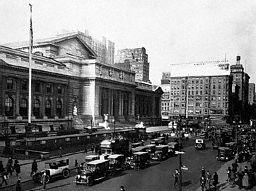 Having established herself as a gifted writer in New York and
having the advantage of access to good publishers there, Lee set
out to publish a book of her poetry.
One of her motives, as she explained to Mencken in a letter dated January 15, 1922,
was related to her new interest in promoting the poets of Latin America: "I have decided to print a book of
poems if I find a publisher. My opinion as to the folly of books of poems hasn't changed, but if I'm to carry
out my plan of integrating South American poets, a book of my own is advisable as a starting-point, it seems."
She gathered her old and new
lyrics — a total of eighty-two poems, mostly love songs — into
a manuscript she called "Sea-Change." This title would unify the
different emotional and geographical landscapes depicted in the
work written over the past decade of her life. Her efforts to find
a receptive publisher were successful, not surprisingly, since her poetry had
already gained a wide audience and some critical acclaim, and in
April 1923, Macmillan published her Sea-Change.
Having established herself as a gifted writer in New York and
having the advantage of access to good publishers there, Lee set
out to publish a book of her poetry.
One of her motives, as she explained to Mencken in a letter dated January 15, 1922,
was related to her new interest in promoting the poets of Latin America: "I have decided to print a book of
poems if I find a publisher. My opinion as to the folly of books of poems hasn't changed, but if I'm to carry
out my plan of integrating South American poets, a book of my own is advisable as a starting-point, it seems."
She gathered her old and new
lyrics — a total of eighty-two poems, mostly love songs — into
a manuscript she called "Sea-Change." This title would unify the
different emotional and geographical landscapes depicted in the
work written over the past decade of her life. Her efforts to find
a receptive publisher were successful, not surprisingly, since her poetry had
already gained a wide audience and some critical acclaim, and in
April 1923, Macmillan published her Sea-Change.
Poetry celebrated the book in a review titled
"Words That Fly Singing": "We have been waiting several
years for this book. Long ago we read in Poetry sensitive,
sharp-outlined lyrics signed by Muna Lee, and longed to see them
under covers of their own. […] The book is probably the better for
its long delay. It opens with some lyrics so good the reader warns
himself that it will be hard for the rest of the book to live up to
them, then fools the reader by quite consistently maintaining a
high quality and thereby winning for its writer a place among our
four or five best lyricists."
Among the lyrics in Sea-Change is a sequence of twelve
sonnets which, among other things, express Lee's poignant
realization of the impossibility of denying love. It was a deeply
personal vision that took her back in memory to the Southwest where
she had first fallen in love and then endured its loss. But in a
short lyric she contented herself with this:
I remember you because of a grassy hill
Where the violets grew thicker than the grass,
And through my memory flames and whistles still
A flock of red-winged blackbirds we watched pass.
Because of a rain-filled night I remember you,
And a tree we came on suddenly in the fall,
And a vague horizon that broke and foamed in blue,
— But I do not remember any words of yours at
all. |
The New York Times, however, was not as enthusiastic as
Poetry. It placed her in that school of lyrists led by
Teasdale, saying that she "displays finish, a captivating rhyme,
and she achieves a certain poignancy. But there is nothing new;
there is no unique personality developing itself here."
The criticism in the Times suggests that her poems are
imitative and that is sometimes true. Unlike the popular Love
Songs (Macmillan, 1917) by Teasdale, however, Lee's poetry uses
imagery of the Pan-American landscape
with its unique geological and botanical
features, which gives her work a distinctive character.
Her verse shows the quality of enlightened regional consciousness
that Mencken would soon celebrate as the
"Oklahoma manner" of poetry. She expands it.
She draws on
her knowledge and awareness of natural history to depict the
different scenes in her romantic drama, and thus locates her lyrics
in American nature. Lee also has a habit of seeing the less usual image or seeing
it in a slightly different way, which imparts a freshness to her poems.
Beyond that, her lyrics have a sophisticated
music of their own and, as the Boston Evening Transcript
noted, "there is always something sharply individual in her vision."
The closing poem of Sea-Change reveals her quest for
continued development both as a woman and poet. Originally one of
the lyrics in her "Footnotes," it is the same poem she had
published in the Pan-American Magazine, under the title "I
Who Had Sought God"; but with a new title, "The Seeker," which
emphasizes a more mature understanding that her salvation was
something not to be expected from above, but found only through her
own experience and free will.
Mencken's encouragement of Lee was essential to her poetic success. Soon after the
publication of Sea-Change, she sent him one of the first six copies she had received from Macmillan. With her
characteristic self-deprecating humor, she signed it: "For H. L. Mencken, to whose persistent encouragement of young
writers is due the publication of a great many unnecessary books; this one among them" (May 13, 1923). In her letter to
him, she elaborated: "A good deal of the responsibility for the book lies at your door undeniably. You are, I think, the only
person who has ever considered my verse seriously. Even those whose lives have touched mine most nearly have thought
last, if at all, of my poetry. As it happens, I am absurdly responsive to appreciation
— hence your responsibility.
I can only add my hope that you will find it worthwhile. For though I do not think it would have changed the aspect of the
world for anyone else if I had not written, I know that it would have changed it for me. And I have always felt grateful to you."
With the publication of Sea-Change and the subsequent
flourish of her poetry appearing in a wide range of magazines —
American Mercury (Mencken's new monthly; see "Mushroom Town"), New Yorker, Current Opinion, Saturday Review of Literature,
Literary
Digest, New Republic, Commonweal, and
Poetry, among others — Lee would establish herself not only
as an important poet on the scene of the new American writing, but
as a major voice in Mississippi and Oklahoma verse. Her uncollected poems,
which would also appear in various anthologies, show her greater
maturity as a writer.
Sea-Change remains the only book of her own poetry that she
ever published. She was content with contributing poems to the periodical
literature, for it allowed her to reach a wide audience. And since
the early 1920s, her poetic endeavors had begun to expand
with her new commitment to serving others as a translator of Latin
American poets. Nonetheless, some twenty years
after the publication of Sea-Change, she would lament that
the book was out of print "since it is my poetry that means most to
me." Indeed, she always thought of poetry "as daily fare […] as
being as much the daily bread as the white hyacinths of life."
The publication of her book in the spring of 1923 was a joyous
occasion for Lee, but her marriage had then taken a distressing turn
when Muñoz left her and their children (as well as his
mother) in Teaneck, so that he could return to Puerto Rico to
compile his father's unpublished works, and participate more
actively in the island's politics. She chose not to follow him into an unstable life again.
Her sense of responsibility as a mother of two young children kept her at home in Teaneck, and close to New York
and the publishers there on which she depended for income.
He lived in Puerto Rico without
his family for almost two years, before returning to them after his
disenchantment with the outcome of the November 1924 general
elections there.
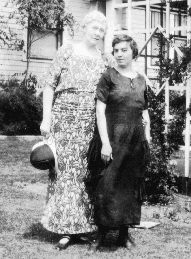
In March of that year, while visiting her family in Oklahoma City, Lee
gave as a gift to an old friend a copy of her Sea-Change, in
which she inscribed: "The days that make us happy / make us wise."
Her life had certainly changed dramatically — for better or worse
— since her Oklahoma days, and she lived in a completely
different world, the one she needed in order to thrive as a
writer. Now, moreover, she had embraced two causes that would become
central to her career, namely, feminism
and Pan-Americanism.
For Lee, these two causes were intimately connected. Her marriage brought them
together. Her later choice of Puerto Rico as her home would nurture them. Throughout the twenties,
by which time recent U.S. intervention in Latin America and strong nationalist movements there had lessened the
attraction of Pan-Americanism, she remained true to the cause. Her Pan-Americanism, at heart, was always romantic
and idealistic. Initially, it had much to do with her campaigns for women’s rights, as well as her dream of
political harmony between the Americas, where Latin American critics had come to view the United States
as the imperialist "Colossus of the North."
She would dedicate the rest of her life to creating various forms of inter-American cultural
relations, especially literary ones ranging from poems to programs, intended to help build
bridges between the different nations for mutual acquaintance, understanding, and respect — what she
considered basic ingredients for a better world.
In the Pan-American Literary Tradition
In 1925, as a translator and advocate of Latin American poetry,
Lee made her first major contribution to the Pan-American literary
tradition which dated back a century to the pioneering work of
William Cullen Bryant, the premier translator of Latin American
poetry in his day. Her achievement was an
expression of everything she was and had become by 1925, the year
that Poetry published a special issue in June, called its
"Spanish-American Number," of which she was guest editor. This
landmark publication, among the first of its kind in the history of
twentieth-century literary magazines, presented poems by thirty-one
contemporary authors (all but three living) whose work Lee had
selected and translated into English.
Lee's earliest translations from Spanish had appeared in 1920 in
Thomas Walsh's Hispanic Anthology, a collection of verse
translations made by "some of the greatest poets of England and
America," in which Bryant's work is amply represented (including
his famous rendering of José María Heredia's "Ode to Niagara"). The anthology was published by the Hispanic Society.
Walsh was a friend of hers; in fact, he was the mutual friend who
the previous year had introduced Muñoz to Lee, saying
that "two young bi-lingual poets" should know each other.
Lee's contribution to his anthology consisted of four translations, one short lyric
by the mid-nineteenth century Spanish poet, Gustavo Adolfo Bécquer, and
three short lyrics by contemporary Latin American poets, Fabio Fiallo
of the Dominican Republic, Rufino Blanco-Fombona of Venezuela,
and Enrique González Martínez of Mexico.
The love poems of Bécquer, Fiallo, and Blanco-Fombona
are natural extensions of the love poetry she
herself had been writing; for example, Blanco-Fombona's "At
Parting":
My love had known fifteen springs —
I kissed, and I pressed to me
Her lips like a flower, her chestnut hair,
Beside a lyric sea.
"Think of me; never forget,
No matter where I may be!"
— And I saw a shooting star
Fall suddenly into the sea. |
Her other translations are equally poetic in their attempt
to re-create the poetry of the original Spanish. The poem by Martínez, his famous poem "Tuércele el cuello al cisne" (which she renders
as "Throttle the Swan"), articulates the attitude Lee shared toward European affectations among American poets.
Four years later, in May 1924, Lee published an essay in the
North American Review, titled "Contemporary Spanish-American
Poetry," in which she provides an overview of major trends; it was
done while preparing her project for Poetry. In attempting
to answer two "fascinating" questions she poses — "What of the
voices that sound most clearly above the chorus? What is their
method, and what its results?" — she states: "A poet may express
his environment in either of opposite ways: by an interpretation of
it or by a reaction against it. Certainly the best contemporary
example of the former method is José Santos Chocano; of the latter,
Rubén Darío." She then discusses their work, providing as examples
her translations of selected poems. In addition, she addresses
those poets who revolted against the "shining and honied things"
produced by Darío and the followers of his Modernismo.
Lee's feminism led
her to consider Latin America's women poets as well: "the mystic
who prefers to be known as Gabriela Mistral," who "is more often
concerned with the invisible than with the visible world," but in
whom is still found "the awakened social consciousness"; "that
lovely and dauntless and irresistible seventeenth-century Mexican
nun, Sister Juana Inez of the Cross"; Uruguay's "most popular and
very talented woman-poet, Juana de Ibarbourou"; and Alfonsina
Storni of Argentina.
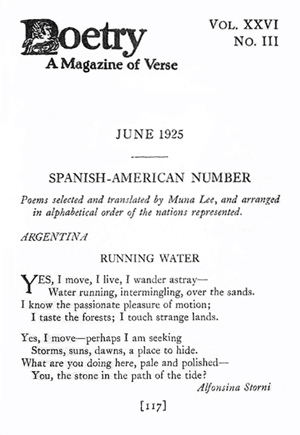
Comparing the poetry of last two poets, Lee says,
"Alfonsina Storni's work, while sometimes carelessly finished,
seems to me of firmer texture and more original quality than Juana
de Ibarbourou's." More significant is Lee's comment that "both,
however, show a new insight — new, at least, in the literature of
their race [ethnicity] — into feminine psychology; the young Argentine
speaking characteristically in 'Running Water'":
Yes, I move, I live, I wander astray —
Water running, intermingling, over the sands.
I know the passionate pleasure of motion;
I taste the forests; I touch strange lands.
Yes, I move — perhaps I am seeking
Storms, suns, dawns, a place to hide.
What are you doing here, pale and polished —
You, the stone in the path of the tide? |
This lyric would be the opening poem in the Spanish-American
anthology she produced for Poetry.
In concluding her essay, Lee acknowledges that she had "simply
offered a foot-note to a richly interesting literature of which we
think too seldom." She ends by saying that "this ferment of
creation to the south of us, in conjunction with our own quickened
interest in poetry, is perhaps helping in the achievement of the
Pan-American character." This character, she adds, requires a
multicultural fusion — "a vision worth pondering."
Poetry's 1925 publication of its special issue devoted to the
work of Latin American poets enabled Lee not only to pursue her new
passion for the literary landscape of Latin America, but also to
embrace the art of translation and its poetic challenges. In "A Word from the Translator,"
following the presentation of the poetry, she explains:
| In making the English versions of
these poems, my intention has been to reproduce, as nearly as
possible in our very different vocables, the meaning, sound, and
atmosphere of the Spanish. Our scarcity of feminine rhymes, as
opposed to the Spanish abundance, has sometimes prevented an exact
counterpart in rhythm, but I believe the rhythmic effect is
always, to a fair degree, the same. […] In every case the original
form has been reproduced with its pattern of rhyme, assonance, or
unrhymed lines. |
Acknowledging the limitations of her anthology, she says that it
is "a suggestive collection, a cage in which humming-birds and
parroquets, flamingoes and blackbirds are represented, as well as
the condor and the tropic nightingale. It does little more than
suggest, faithfully and gratefully, something of what readers of
the poetry of our sister republics may expect to find." Nonetheless,
this modest anthology gave many readers for
the first time a strong introduction to the poetic brilliance and
innovation of voices little known in North America.

Lee selected work by a wide range of poets, many of whom would
later establish themselves as major figures; they represented
fourteen Spanish-speaking countries of South America, including the
Caribbean. In most cases, she offered one poem by each author.
She presented work by most of the poets she had discussed in the
North American Review: Darío, Chocano, Storni, Mistral,
Ibarbourou, Enríque González Martínez, Luis Palés Matos, Leopoldo
Lugones, and José Asuncíon Silva.
Her translation of Silva's "Nocturne" shows how
well she herself could work with free verse, re-creating his poem with its
expressive cadences and haunting music. At the same time, she understood
the impossibilities of translation, and elsewhere said that "it is only partially
translatable — that is, so much of its beauty depends upon the
intricately braided jet and silver of its cadences that a great
deal is necessarily lost by translation into a less liquid tongue."
But also recognizing the poetic possibilities of translation, she added that
"it has strength enough, however, to remain a poem even though some
of the music vanishes — a poem which, even in translation, more
than any other that I know, really chills the listener, across
whose consciousness seems to blow the cold wind of
mortality":
One night,
One night filled with murmurs and perfumes and the music
of wings,
One night
When fantastic fireflies blazed in the moist nuptial
shadows,
By my side slowly, clasped to me, paler and silent,
As if a presentiment of infinite bitterness
Agitated the most secret depths of your heart,
Over the blossomy path through the meadow
You wandered;
And the full moon
Scattered white light over bluish skies, boundless and deep.
And your shadow,
Frail and languid,
And my shadow
By the rays of the moon projected
Over the gloomy sand,
Joined together
And were one,
And were one,
And were one,
And were one long shadow,
And were one long shadow,
And were one long shadow.… |
Concerning Silva's voice,
she was quick to perceive the inter-American connection he had with Edgar Allan Poe;
her essay, "Brother of Poe," published in the July 1926 issue of Southwest
Review, is one of the earliest studies on the subject of Poe's
influence on Silva.
All told, Lee's brief anthology successfully offered an
impressive glimpse of the robust poetic activity in Latin America,
and showed that, in the words of Poetry's editor, Harriet
Monroe, "the Spanish-American style in poetry is more expansive
than the modern fashion among our own poets has encouraged. One
finds little of that stern compression which has been our
discipline during most of the present century, and a more eloquent
elaboration of motives than is instinctive in the Anglo-Saxon mind
or customary in English speech." (The subsequent growth of North
American poetry, in the decades immediately following the Second
World War, would thrive on lessons learned from the vitality of
this "Spanish-American style.")
In the issue, Lee also made a historic comment, albeit short. Using the pseudonym of Pablo Matos (to vary the credits to her), she reviewed an anthology of contemporary Chilean poetry, and made what was apparently the first-ever mention in English of "Pablo Neruda, with his unequivocal pictures of youth tortured by desire." At that time Neruda was just twenty, and with his second book, Veinte poemas de amor y una canción desesperada (1923; Twenty Love Poems and a Song of Despair), he had already established an international reputation as a poet; indeed, the poet destined to become Latin America's pre-eminent bard of the twentieth century. (Lee later distinguished herself in the 1940s as an astute and early critic of Neruda's influential Residence on Earth poems in English translation.)
In the preparation of this transnational issue of Poetry, Lee was
assisted by several Latin American poets and critics, including of
course her husband. Muñoz contributed a commentary
titled "A Glance at Spanish-American Poetry," appearing at the end
of the issue. A brief account of major contemporary trends, his
essay includes a remarkable statement about the significance of
poetry written by women:
| Perhaps the most interesting
departure within the modernista movement — itself
the most interesting of all departures in Spanish poetry since the
century of Góngora and Quevedo — is the recent release of the
lyrical tongues of women, which had hitherto spoken either not at
all, or else with prim conventionality. Militant femininity — not
feminism — has broken down formidable barriers of social prejudice
with a sweep of glory. |
With his well-known macho disposition, Muñoz had surely
had his eyes opened to this new phenomenon by his wife who, by
1925, was becoming increasingly involved with American women's
struggle for equal rights in society. Lee always challenged his
thinking about women and their social roles. Just as her marriage
with him was also a marriage with the literature and culture of
Latin America (the one that never ended), his was a marriage with
the ideas of the bold "new" American woman.
The Spanish-American issue of Poetry closes with Lee's
review of the first book by Mexican poet Jaime Torres Bodet, in which she points out the
"graphic quality in his phrases" and provides as an example of it
her translation of the following image:
Silence, in some women,
Is a bough heavy with birds. |
Her selection of this particular image reveals more of her own
concerns and temperament than the author's. It is, moreover, the
final poetic image encountered in the entire issue which, as noted
above, opens with her rendering of Storni's female voice. Like Storni,
in whose works at the time the themes of love and feminism predominated,
Lee would soon raise her powerful voice to champion women throughout
the Americas, not in poetry but in the political arena.
The Bulletin of the Pan American Union —
"believing that the road to that real understanding between
nations which is the very essence of all Pan American ideals will
be found in cultural rather than commercial or political contacts" —
opened its July issue with an editorial tribute to Poetry's
"Hispanic American edition," followed by
a group of Lee's translations taken from it.
Lee was described as "the ardent young Hispanist and poet who
served as translator," and her achievement hailed as "a distinct
contribution to Pan American letters and inter-American
friendship."
In August 1925, Lee and Muñoz sold their house in Teaneck and moved back to New York.
Together, they soon established their West Side apartment — on Riverside Drive above 100th Street — as a gathering place for literary figures, such as poets Horace Gregory, Marya Zaturensky, Sara Teasdale, William Rose Benét, W. Adolphe Roberts (whose 1949 novel about the Spanish-American War, The Single Star, would be dedicated to Lee "in token of long friendship and because she profoundly knows and loves the Caribbean scene"), and Constance Lindsay Skinner (see Jean Barman's Constance Lindsay Skinner). Indeed, their
well-known Sunday night "open house" parties included these
writers, among others, as well as teachers, explorers, diplomats,
dilettantes, artists, revolutionaries, and mercenaries, even
Spain's famous bullfighter, Juan Belmonte. Skinner, a close friend of Lee's,
who then was working in New York as a literary critic for the New York
Herald Tribune, was often co-hostess of these lively soirees, which had two firm
rules: no invitation required, and no recitation of anyone's
poetry.
"Why," a poet friend asked Lee at one of them, "do
you insist so on wildflowers and rain?" She replied:
| Because of a childhood on a
prairie without trees, without mountains, far from the sea — but
alive and joyous with foxglove and wild rose and verbena and
California traveler and a hundred more. A childhood amid dust and
glare and heat — and the sudden great floods of rain — even the
dullest spirit must be thrilled by rain over parched
prairies […]. |

In his autobiographical work, The House on Jefferson
Street, Horace Gregory recalls the Sunday night parties he
attended at the home of Lee and Muñoz:
Their guests were an extraordinary
combination of Arctic explorers,
European journalists, young New York writers, Spanish-American
military men, and soldiers of fortune: talk was of revolution, the
wisdom of the Eskimos, reindeer meat, the novels of D. H. Lawrence
and James Joyce, the poetry of Robinson Jeffers. Political,
military, and literary arguments ran their continuous course
throughout the apartment in whispered manifestoes of political
discontent; with them flowed the names of Marx and Unamuno,
Bertrand Russell and Croce, Freud and Veblen, and over these
warring factions weaved the host, handsome, witty, a delightful
mimic, and ineffably tactful, a forefinger vertical at his lips,
silencing a raised voice by giving its owner a fresh tumbler of
bathtub gin.
No less successful at keeping order among their social fauna
was his matronly young wife, who wore a Spanish shawl in swirling
reds and blacks and orange tossed over her shoulders and a dove-gray evening dress. Her large brown eyes dispelled all rudeness,
and the lightest touch of her tapered fingers on the sleeve of a
guest's jacket would be sufficient warning to lower voices.
To sustain arguments, slogans would be quoted, phrases and
sentences trembling in air: then perhaps, the recital of a few
lines of verse […]. |
Gregory adds that on those Sunday nights, he felt part of "a
more recent, more 'serious,' somehow more responsible
generation than that which drifted off to Paris soon after World
War I." This seriousness was an everlasting quality of Lee's character.
The daily realities of her present life demanded it, with motherhood
and household duties, reading and writing work, not to mention marriage.
Furthermore, her politics compelled her to take life seriously
and take part in society.
The period of the mid-1920s also saw Lee expand her work as a
literary translator to include prose from Latin America — the translation of which was
a labor of love she pursued throughout her life. In the spring of 1926,
her critically-acclaimed rendering of
(General) Rafael de Nogales's Four Years Beneath the Crescent
was published by Scribner's. The war memoirs of a Venezuelan
soldier of fortune serving with Ottoman forces in Turkey and the
Near East during the First World War, the original Spanish had just
been published in Spain in 1924. The author's observations of the
massacres in the Near East made him distinctly persona non grata in
the official quarters from whence issued the laconic order to
burn — demolish — kill. Luckily he escaped assassination and,
receiving honorable discharge from the army, returned to Venezuela
to write these memoirs.
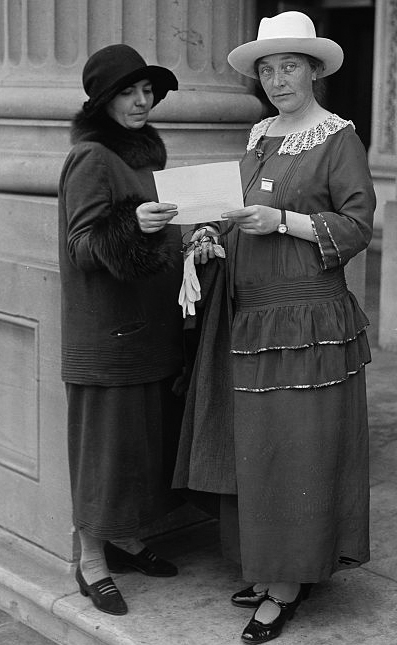
The publication of Lee's translation of his adventure story
created a sensation among critics. Highly favorable reviews
appeared everywhere. The New York Times said that "the
book, delightfully and feelingly written, would be worth its weight
in thrills, if every page weighed a ton, as a tale of chivalry in
the age of iron." The Review of Reviews said that "one
should not dismiss it as merely a narrative of a soldier of
fortune. It is that and much more." The Boston Evening Transcript
called it an "engrossing volume" — and at 416 pages it was a
sizeable volume. Acknowledging the literary feat of Lee's
translation, the New York Herald Tribune said:
| There is present in this
military Don Quixote always the Latin love of beauty. […] And the
picturesque imagery, the vivid objectivity which his style often
achieves is so perfectly rendered by Muna Lee's translation that
the reader finds it difficult to realize that he is not reading
Nogales in his own Spanish idiom, or that Nogales has not told his
tale in English. |
Indeed, giving a strong voice to others, whether by means of
translation and other forms of writing or by use of the podium,
had become the focus of Lee's career.
Speaking Out for Pan-American Women
In the summer of 1926, Lee moved back to Puerto Rico with Muñoz. He had been offered the directorship of
the prominent newspaper his father had founded in San Juan, La democracia.
He also wanted to "go home" in order to engage more actively in the politics of Puerto Rico,
where glaring inequalities in wealth
contributed to sharpened social and political tensions. He was bent
on helping to bring about the economic reform needed to improve the lives of the
island's forgotten working class. Such reform had become a major
issue in the new climate of freedom in Puerto Rico that followed
enactment of the 1917 Jones Act, which gave it a measure of
political autonomy from the United States.
Signed into law by
President Woodrow Wilson, the Jones Act extended U.S. citizenship to Puerto Ricans for the first time. It also
established a locally elected senate and house of representatives, modeled after the organization of the
Congress in Washington. The local political leadership continued to be obsessed
with the status issue. This issue loomed large in Puerto Rico, with arguments about the ideal form
of autonomy it should have, while the United States maintained that it could not give Puerto Rico statehood or
independence until the island lowered its illiteracy rate. Muñoz believed that independence should always be in the program
of a serious political party, and at this time, in the mid-twenties, he was an outspoken supporter of Puerto Rican independence.
Energetic as always, Lee ran their large household. The paper
prospered under his directorship, and for the first time the family was financially
secure. Nonetheless, in addition to her responsibilities at home
and her continued literary activity, Lee started to work for the
University of Puerto Rico, in January 1927, as director of its
bureau of international relations. This position appealed to her
interest in Pan-American cultural affairs. It gave her a position
of her own in the world, as well, outside of the home. She would
hold it for more than a decade; with the exception of a two-year
leave of absence in the early 1930s to work for the feminist
National Woman's Party (NWP) as director of national activities.
As the university's lead publicist, she prepared daily press
releases in both Spanish and English; wrote a daily newspaper
column on international, educational, and cultural relations, about
which she would lecture widely; and acted as liaison with
educational and cultural representatives in the United States, the
other American republics, Spain, and England. She would also write
and edit numerous special publications for the university, and find
time to teach English literature there. In the years to come, she
prepared and supervised radio programs, as well as inter-American
literary conferences. It was a position that challenged her
intellectually and creatively. It also kept her close to the
literary scenes in both South and North America.
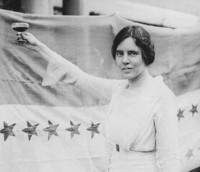 Soon after arriving in Puerto Rico in 1926, Lee became actively
involved with the women's suffrage movement there, which had been
gathering momentum since the turn of the century. She had long
been a supporter of the suffrage movement in the United States, and
the young NWP founded by Alice Paul, who spearheaded the movement's
drive to victory in 1920. When Paul led pickets on the Wilson
White House, and brought thousands of women from across the country
to march for equality, Lee was always cheering for them; for it was
her cause, too.
Soon after arriving in Puerto Rico in 1926, Lee became actively
involved with the women's suffrage movement there, which had been
gathering momentum since the turn of the century. She had long
been a supporter of the suffrage movement in the United States, and
the young NWP founded by Alice Paul, who spearheaded the movement's
drive to victory in 1920. When Paul led pickets on the Wilson
White House, and brought thousands of women from across the country
to march for equality, Lee was always cheering for them; for it was
her cause, too.
Having fully identified herself with the struggle of women for
equal rights in a democratic society, Lee naturally embraced the
cause of her sisters in Puerto Rico. Throughout the island, she
gave speeches and wrote articles defending their right to vote; the
island's legislature, in 1929, would finally pass a law granting
"literate" women the vote (universal suffrage was not won for all
Puerto Rican women until six years later).
During the course of her feminist activism in Puerto Rico, Lee
formed close ties with the leadership of the NWP. Since the
passage of suffrage, the party's primary goal had been (and still
is) to educate the public about the Equal Rights Amendment.
Education was the tool the party used to create change — an
approach in which Lee had undying faith. Just five years before
Lee returned to Puerto Rico, Paul had authored the Equal Rights
Amendment to the U.S. Constitution, guaranteeing "equal justice
under the law" for all citizens, regardless of their gender. This
proposed amendment articulated what Lee had long believed was a
social right of not only the women of the United States, but of all
women in the Americas and the rest of the world.
Lee's unique position as both an adopted daughter of Puerto Rico
— a virtual native in many people's eyes, given her marriage — and a born
citizen of the United States, combined with her brilliant political mind and her rhetorical powers,
gave her the credentials to speak out on behalf of Pan-American
women. She had already established herself as a leading member of
the Puerto Rican branch of the NWP.
In January 1928, as the delegate representing the women of
Puerto Rico, she went to Havana to join forces with a large group
from the NWP led by Doris Stevens, chair of the party's committee
on international action. This group, composed of women from the
United States as well as other nations of the Americas, had
gathered there to confront the Sixth Pan-American Conference (of
the twenty-one member nations of the Pan American Union), in order
to demand an audience for women's rights. Specifically, Lee and
her sister feminists wanted the members of the conference to ratify
a treaty giving equal rights to men and women before the law in all
twenty-one countries of the Pan American Union; drafted by Paul of
the NWP, the proposed treaty was intended to move the consideration
of women's rights into political debates throughout the
hemisphere.
In her published report of the event, which later appeared in
the Nation as a letter to the editor, Lee recounted:
| Sandino [whose guerrilla army in
Nicaragua was then battling the U.S. Marine Corps sent to maintain
imperialist policy] was kept out of the Sixth Pan-American
Conference at Havana, but the Woman's Party of the United States
got in. The conference had a definite program to work from, and a
definite plan for dealing with it. The question of equal rights
for women was not in that plan. When the Fifth Pan-American
Conference in Santiago de Chile in 1923 recommended on vote of
Maximo Soto Hall, delegate from Guatemala, the inclusion in the
agenda for the succeeding conference of a study of methods for
obtaining equal rights before the law for the women of the twenty-one American countries, no one — probably not even Sr. Soto Hall
himself — expected much. |
Despite the expectations raised five years earlier, in 1923, not one woman was
included in the delegation of any country. Lee noted that the
"Sixth Conference […] certainly did not dream of a feminine
invasion. Women had never disturbed the Pan-American delegates by
so much as a petition." The conference delegates argued that only
they were allowed to speak on the floor and that the meeting's
agenda had no room for discussion of a treaty on equal rights.
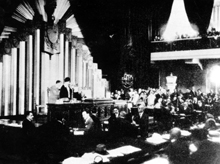 After a month of protests and active campaigning in Havana, the
women were finally allowed a voice at the conference. They had
successfully petitioned to gain the necessary "invitation" for an
open hearing. For the first time women would officially speak at
a plenary and public session. Lee and seven others — including
two women from the United States, four from Cuba, and one from the
Dominican Republic — presented their case briefly and urgently.
After a month of protests and active campaigning in Havana, the
women were finally allowed a voice at the conference. They had
successfully petitioned to gain the necessary "invitation" for an
open hearing. For the first time women would officially speak at
a plenary and public session. Lee and seven others — including
two women from the United States, four from Cuba, and one from the
Dominican Republic — presented their case briefly and urgently.
To hear their speeches, women thronged the galleries, staircases,
and the conference floor of the University of Havana's great hall.
Lee described the scene in her report:
| Fifteen hundred women who had
crowded into the Aula Magna of the university and had been
standing, waiting, an articulate, swaying mass, for more than three
hours, burst repeatedly into joyous applause which was echoed here
and there from the places where the delegates listened with divided
emotions but unified attention. Outside, thousands were crowding
up the splendid flight of white stairs, while the radio amplifiers
carried the speeches through the bright Cuban
air. |
Addressing the conference with brilliant poise, Lee spoke
elegantly and intelligently; and like the NWP's lead speaker, Doris
Stevens, she invoked the ideals of Pan-Americanism:
| Many temples have been built to shelter
Pan-Americanism. Some of them have been built with marble, some with words.
[…] But here, today, you have before
your eyes a concrete demonstration of that very thing: a Pan-Americanism that includes all, that excludes none, that makes not
the slightest difference between one and another. The women of all
the Americas have one need. Every enlightened woman of this
hemisphere desires for her sister of another country, the same good
which she craves for herself. The woman of no country of our
Americas believes that equal rights for herself will in any way
give her or her country an advantage over her sisters to the north
or the south. She does not wish such advantage. She does not ask
for one thing and pay with another; she is not carrying on a barter
of power, of friendship, of advantage. She asks for herself and
for every other woman in all of our countries, one thing, for the
good of all — for the good of those countries which we women have
helped upbuild and are helping uphold. |
Furthering her idea of a "Pan America" where freedom and
equality truly reign, for she was also the only person representing
Puerto Rico in any way at the conference (communicating ideas that were secretly
in behalf of Puerto Rico's Suffragist Social League), she stated:
Our position as women,
amongst you free citizens of Pan America, is like the position of
my Porto Rico in the community of American States. We have
everything done for us and given us by sovereignty. We are treated
with every consideration save the one great consideration of being regarded
as responsible beings.
We, like Porto Rico, are dependents. We are anomalies before the
law.
We, the women of the Americas, ask for a treaty granting us
equal rights before the law. We ask this not for one woman, not
for one country, not for one race, but for the women of Pan
America; for the women who are proving to you here today by their
solidarity and mutual trust that Pan-Americanism is a
fact. |
In an editorial that appeared on the afternoon following the
women's speeches, Cuba's leading newspaper said that "we are glad
the conference granted the women that hearing, else we should
likely have seen something comparable to the storming of the
Bastille!"
The Equal Rights Treaty was not ratified. However, Lee and her
group of feminists did gain an immediate response from the
delegates of the conference, who unanimously voted to have the
report on equal rights received and discussed in plenary session
rather than in one committee. When that report was made, a
resolution was passed declaring that an Inter-American Commission of
Women be organized to prepare information to enable the next
Pan-American Conference to study constructively the civil and
political equality of women. The commission would initially consist
of seven women designated by the Pan American Union, and the number
would be increased by the commission itself until each of the
twenty-one member nations gained representation in it. The first
inter-governmental agency in the world created expressly
to ensure recognition of the civil and political rights of women,
the commission was destined to form an integral part of the Pan American Union and subsequently
the Organization of American States.
The creation of the commission, of which Stevens would serve as
its first president, reflected the growing cooperation between the
women of North and South America, a Pan-American sisterhood in
which Lee would play a leading role in the years to come. In the
Nation, she noted that "the enthusiasm and energy of the
Cuban women was [an] unequivocal answer to all who had ever said
(and how many they have been!) that the Latin woman does
not want her rights; that the Latin woman will not speak
in public; that the Latin woman is bound by customs which
she cannot break." She concluded her report with a bold statement of her conviction: "The
struggle for equal rights has become an inter-American movement.
The women of no country will look upon the cause as won until it is
won for all. Here at last is a unity of ideal and effort which
establishes a real, a spontaneous, a spiritual commonwealth of Pan-America."
During the summer of 1928 (as well as 1929), Lee took a leave
from the University of Puerto Rico to work as director of public relations
for the Inter-American
Commission of Women in Washington. After prolonged consultations
with jurists and feminists, Stevens had decided that the vexed
subject of the nationality of women would be the first subject of
research by the commission. Lee conducted juridical research for
this project, in addition to doing
public relations work for the commission, and helping run its
office.
To help gain support for the commission, she wrote articles and
gave lectures about it. In the October 1929 issue of Pan-American
Magazine, she published one such article, "The Inter-American
Commission of Women: A New International Venture," in which she
said:
| There can no longer remain in
the mind of anyone privileged to witness the swift development of
this splendid feminist activity, any lingering doubt as to whether
a Pan American movement can flourish in spite of barriers of race
and language. The Inter-American Commission of Women is proving
every day that such barriers are imaginary; like the wall in the
fairy story which is there only so long as one believes it to be
there, but which can be walked through and brushed aside by the
ardent spirit with an invincible ideal. |
In addition to doing articles and lectures in English, she
did the same in Spanish, spreading the good news throughout the
Americas.
With the World on Her Back
Lee's marriage with Muñoz had become increasingly strained ever
since their return to Puerto Rico in 1926. Their lives were
diverging as they pursued their different passions for public life
and politics, as when he had left her for the island in 1923. The
family's financial security did not last long. In the summer of
1927, for largely political reasons, he was forced out of his job
at La democracia and went to live in New York without Lee
and their children. He had told a colleague "the flame trees" were
giving him "indigestion," and that he needed to spend some time in
New York, where "the evening lights of Fifth Avenue, as agreeable
as usual, are a marvelous tonic." He staid at the swanky Vanderbilt
Hotel, on the corner of Park Avenue and 34th Street. Initially, he busied himself
as the representative of the Economic Commission of the Legislature
of Puerto Rico, with the purpose of persuading American businessmen
to invest in the island's economic development.
Two months after Muñoz had left, he sent Lee a cable from New
York. He was flat broke, and needed her to send him some money; he
had spent almost all of what little he had. At the time, Lee was
essentially the main supporter of her household, on her annual
starting salary of $1800 from the University of Puerto Rico. She
responded to him with a letter that said:
| Your cable yesterday afternoon inspired me
(you will forgive me?)
with a wild desire to shriek with laughter. Doubtless you will
realize why, reading the letter I had just mailed you before
receiving the cable. I am so sorry you are in difficulties but I
can do nothing. I can't even send you a cable saying "Impossible."
I can appeal to no one. […] You must learn to select,
to control, to manage, Luis, if you are ever to have any comfort or
pleasure in life — or any freedom. I know you have had a very
difficult two months. So have I. The Democracia has not
paid Mamá anything so far this month […]. I not only cannot
help you in any financial way, but I shall be utterly lost and
undone if you cannot manage to help us immediately. Believe
me, our need is desperate, or I should not beg for money — and
continue to beg. […] It is hard for me to write about anything
but money because that is what fills my mind and keeps me awake
nights. We cannot help you, Luis. I don't know how you can arrange
to help us, but you must. |
Despite this tension which eased only sporadically, at the start
of 1928, Lee and Muñoz were together in Havana at the Pan-American
Conference, where he was relegated to the role of an English-Spanish interpreter.
But then she went back to Puerto Rico, and he to New York.
For nearly three years, he lived there on his own, earning
some money from his writing, and also enjoying himself, as
when he bought a beat-up Ford and traveled across the country.
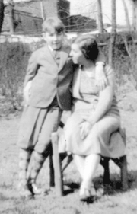
In January 1930, Lee published her "Rich Port" in Mencken's
American Mercury. This confessional poem, which later
appeared in several anthologies, records her own misery in terms of
Puerto Rico's. The poem alludes to the devastating earthquake of
1918; its epicenter was located northwest of Aguadilla in the Mona
Canyon (between Puerto Rico and the Dominican Republic).
Accompanied by a tidal wave that was twenty feet high, the
earthquake had a magnitude of nearly eight on the Richter scale,
and caused severe damage to numerous houses, factories, public
buildings, bridges, and other structures. Here the devastation
that Lee's marriage had suffered is likened to this natural
disaster with its foreboding of doom:
This desperately tilted plane of land, our
island,
Toppling from its gaunt sea-rooted pillar,
Slanted ever more definitely toward the sea-floor,
Toward that bottomless rift in the floor of Mona Passage,
Slipping,
sliding,
creeping,
ever more surely
This doomed beloved rock edging inch by inch with the
earthquakes
Toward implacable disaster,
Some day will lurch, will plunge, the long tension ended,
And the ceibas and the yellow fortress and the lizards and the
market-place,
The wild beauty of mountain cliffs hung with blue morning-glories,
Immaculate cane-fields and the cool breath of coffee-groves,
Thatched hovels and trolley cars and Ponce de Leon's palace,
Flame-trees and tree-ferns and frail white orchises,
My love and your pride,
All, all will lie in crushed indeterminate wreckage for a thousand
thousand years
In the crevasse beneath the floor of Mona Passage,
With aeons of sea creatures moving lightly through the heavy masses
of water
Far above the shattered nameless shards
That in 1930 were you and I
And flame-trees and Porto Rico. |
When Muñoz returned from New York to Puerto Rico in early 1930, Lee
was living with their children and his mother, and he stayed at the
Palace Hotel. They would later live together in a certain fashion for a few years,
however, before separating for good. It is hard to pinpoint exactly when,
but he would ultimately leave her for
another woman, a political associate of his, named Inés Mendoza, with whom he started
a relationship in the late 1930s. The daughter of an illiterate jíbaro (peasant),
she had become a schoolteacher, then joined Muñoz's peaceful revolution to free the
poor jíbaros from hunger. She worked closely with him in his grassroots campaign,
and traveled with him all over the island (in 1938, he recalls in a memoirs, in the
"human and spiritual sense" his marriage with her began).
Doing for Others and for Herself
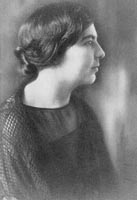 In June 1930, Lee took an extended leave of absence from the
University of Puerto Rico, in order to work for the NWP in
Washington. She lived at the NWP headquarters (Alva Belmont House) with her two children, and she served
for two years as director of national
activities, which involved writing publicity, arranging radio
broadcasts as well as national and state conferences, and giving lectures
on the subject of women's rights, in particular their right to work. The
Depression was slowly beginning to affect working women and their
jobs. Plants and offices were forced to fire hundreds of women
employees, and many factories re-instituted old regulations
prohibiting women from working at night.
In June 1930, Lee took an extended leave of absence from the
University of Puerto Rico, in order to work for the NWP in
Washington. She lived at the NWP headquarters (Alva Belmont House) with her two children, and she served
for two years as director of national
activities, which involved writing publicity, arranging radio
broadcasts as well as national and state conferences, and giving lectures
on the subject of women's rights, in particular their right to work. The
Depression was slowly beginning to affect working women and their
jobs. Plants and offices were forced to fire hundreds of women
employees, and many factories re-instituted old regulations
prohibiting women from working at night.
Facing an economic calamity that could imperil the future
progress of women's rights, the NWP launched a major nationwide
campaign to protect women's employment. The party primarily
campaigned in protest of laws and regulations that enabled bosses to fire women on
the basis of marital status or job conditions, such as night
jobs.
In accord with the NWP position, Lee argued all over the country
against so-called protective legislation for women workers.
Speaking about their right to work at night, she said: "The Woman's
Party, as we should make clear, does not advocate night work. If
night work is bad, it should be discontinued for both men and
women. But it holds that night work is preferable to no work at
all."
She became widely known for her opposition to "any
legislation on a sex basis" and her belief that all laws and
regulations governing workers "should be based upon the nature of
the work and not upon the sex of the worker."
In 1931, in line with these convictions, she battled the action
of the Cotton Textile Institute that had discontinued night work
for women in cotton textile plants both in the North and the South.
Her opposition had no immediate effect, but later in the 1930s, the
policy of non-discrimination against women workers, for which she argued
using both the spoken and written word, later
found its way into legislation in various states. (Discrimination
against women in employment was not prohibited until the passage of
the federal Civil Rights Act of 1964, the year before Lee's death.)
This ardent feminist activism, together with her other efforts
on behalf of women's rights, in particular her work with the Inter-American Commission of Women,
would establish her as one of the
prominent feminists of her day, advocating for social reform
throughout the Americas.
Lee's report titled "Equal Rights Approved by American Institute
of International Law," which had originally appeared in November
1931 in the NWP's weekly journal, Equal Rights, was
published that year as a book by the Inter-American Commission of
Women. The news pertained to the party's latest advances in its
continued crusade to have its Equal Rights Treaty adopted — now by the
upcoming Eighth Pan-American Conference, to be held in Buenos Aires. This publication
included the text of the treaty. With her characteristic flair for
rhetoric, she opened with these rousing words:
The dignity of woman was most
dramatically recognized in action just taken by the American
Institute of International Law, and the steady march of women
toward equality was greatly accelerated by this distinguished body
of men.
In their unanimous recommendation of Doris Stevens for
membership in the American Institute of International Law, jurists
of this hemisphere bestowed upon this gallant and beloved Feminist
the highest honor within their gift. […] Miss Stevens is the first
woman to be a member of this distinguished juridical body,
membership in which is limited to five international publicists for
each of the twenty-one American
republics. |
Stevens had also been selected to serve on the institute's
special committee that was delegated to travel to Buenos Aires.
This committee would render its services to the Pan-American
Conference in the discussions about the proposed treaty, which the
institute had just endorsed. Lee celebrated that "for the first
time, a body of men has taken the wholly just and enlightened step
of appointing a woman rapporteur of a committee on the rights of
women." And about their endorsement of the treaty itself, she rejoiced in the fact that "never
has Equal Rights been so quickened in the American hemisphere."
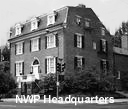
One of Lee's most important personal friendships was with journalist and feminist Ruby Black, who lived in Washington. They had been friends for several years, meeting through the
women's movement, possibly first in Chicago. Black served the NWP as an editor
of Equal Rights; for income, she ran her own news bureau serving daily newspapers in seven states.
Lee's friendship with her would prove to be very significant for Puerto Rico, as well, because through her Muñoz was later able to meet Eleanor Roosevelt and FDR at the White House, and to gain their support for the cause of the island. (Black's relationship with ER started in 1933 when she covered her for the United Press, since the first lady allowed only women at her press conferences.)
While in Washington, Lee still found time to spend a term as
associate editor of the Carillon, a quarterly magazine of
poetry published there, and to contribute poems to Poetry,
American Mercury, Commonweal, and New
Republic, among other magazines.
The occasion of the first Pan American Day on April 14, 1931, inspired Lee to write "Pan American Day in the Park,"
an apparently unpublished work. It is a poem of protest, as much as it is a poem calling for Pan-Americanism.
The new holiday called Pan American Day was (and still is) observed throughout the Americas; the date was chosen to
commemorate April 14, 1890, when the Pan American Union was established. It became an annual event celebrating the
diverse cultures of the Americas and stressing inter-American goodwill.
But in 1931, the first year of the holiday, U.S. intervention had been taking place in Nicaragua for four
years, and a pure celebration of Pan-Americanism was at odds with the political reality. In a departure from her
confessional love poetry, Lee's narrative verse protests the abandonment of the American ideal of liberty:
Washington on a bronze horse called across the park,
"Ho, Bolívar, are you listening?" and the Liberator heard,
Lifted up a brazen sword and answered through the dark,
"Listening, my comrade! What will be your word?"
Lincoln in a marble chair propped his elbow on his knees,
San Martín in a marble cloak attentively gave ear,
Washington spoke boldly so that all of them might hear,
And his speech flamed like a comet through the April trees:
"Yorktown and Ayacucho were one victory," he said;
"At Aconcagua and at Valley Forge we prayed one prayer;
The eagle and the condor the same symbol overhead,
Our conquering banners made a single rainbow in the air!
"Yet the twenty-one republics for whose liberty we died
I fear become forgetful of the oneness of their goal —
Each is proud and rich and mighty; but the greatness of the whole
Will come only when they dwell as sisters side by side."
"You may be right," Bolívar said, and the sternness of his thought
Made the sternness of the bronze a deeper shadow on his brow:
"I fear they grow apart," said Lincoln, "they seem sometimes strangers now."
Then a wailing cry of anguish to their startled ears was brought.
"It is Nicaragua weeping!" San Martín said, "In that cry
The stricken land, the valiant land, is keening for her dead!"
"Listen!" said Bolívar. Lincoln lifted up his head.
"Help comes! Hope comes!" said Washington. "See them hurry by!" |
This poem expresses Lee's commitment to social justice that was at the heart of her work for the NWP —
namely, equal rights. It defines the Pan-American ideal of freedom for all. Interestingly, the final line of
the fourth stanza had originally depicted the nations of the Americas
living "close in friendship side by side." Reflecting her feminist consciousness,
her revision portrays them as sisters, and thus creates the image
of the American nations as family.
Returning to Puerto Rico late
in the summer of 1932, she resumed her work for
the university, as well as living with Muñoz. She continued to
produce poems and essays in both
English and Spanish, and also translations of work by Latin
American writers. Her "Ballad," which appeared in Poetry in
the fall of that year, is reminiscent of her early love lyrics.
It closes a sequence of five poems under the title "Carib Summer."
This particular lyric reveals her return to a painful struggle with love and
the madness of it:
She wandered singing down the street
Nor looked at us at all;
"Love," she sang, "is warm as frost
Kindling the hill in fall!"
"And love," she sang, "oh, love" she sang,
"Is kind as nettles be;
Smooth thistles make its bed, its roof
The shady cactus tree."
She sang the silliest mad song
Of any woman born:
"Oh, love is sweet as juniper,
And gentle as a thorn!" |
Only poetry offered her the language of indirection that she
needed to validate her personal reality and to speak openly of the
disaster her marriage had become, like her former "tale of old
romance." The month after the October publication of her "Carib
Summer," Muñoz was elected to Puerto Rico's Senate. The wife of a
prominent public figure, Lee was known throughout the Americas by her married name, Señora
Muna Lee de Muñoz Marín, and also as Mrs. Luis Muñoz Marín. But she always signed her own name to
her poetry publications, and in this way further affirmed her own
identity.
Her "Deliverance," published in the American Mercury in the
spring of the following year, articulates an acceptance of her
being on her own again, and an affirmation of the silver in the
dark cloud of her life, namely, independence. The poem's very
style expresses her independence, as much as it shows the influence
of contemporary trends:
I am my own now, never need there be telling
Of the thought that lures and lingers and brightens the mind's dark crevice;
Nevermore the difficult choosing of words to make words plainer;
I am my own now, my silence a proud possession;
From the crags and crannies of silence never need there be dispossession.
If the awful apocalyptic vision flare and thunder about me,
Only within myself need I seek for a clue and a meaning;
I may pick windflowers in the fields, showing none how earth has stained purple
The underleaf close to the ground; I may walk in the rain and the dark.
I am my own, and no other can stand between me and the mountains:
Beauty savored slowly in quiet replaces the haste and the voices. |
Romantic love — "the thought that lures and lingers and brightens
the mind's dark crevice" — would no longer shape her life. She had
become more self-reliant, in more ways than one, since writing her early lyric, "I Who Had
Sought God" (later retitled "The Seeker"). Then, she was turning
"blindly" to God with "a weary throng of [existential] questions" in her grief-stricken soul,
"listening for heaven to thunder forth" her name. Now, as she
says in "Deliverance": "If the awful apocalyptic vision flare and thunder about me,
/ Only within myself need I seek for a clue and a meaning."
Still, she struggled with the loneliness that her failed
marriage had imposed upon her. Her "Alcatraz," published in
Poetry in 1934, echoes the sentiment of the group of lyrics
in Sea-Change called "Imprisoned," and depicts this imposed
solitude, and her implicit struggle to endure her husband's
abandonment of her, like the abandonment of her youth in the
Southwest, which had left her feeling cut off from life:
Noon after noon the seabird seeks this
rock,
He who has freedom of all sky, all shore,
Noon after noon he comes from far clouds flying
To perch hereon, as all the noons before.
This crusted boulder, this casual piece of granite,
Is the seabird's star in a universe of cloud,
His plot of earth, his verity, his comfort,
The one fixed point in fluctuant tides allowed.
Not in wide space his joy nor far horizons,
This wildest, freest thing who in unknown
Unbounded oceans of air, oceans of water,
Has found but this harsh certainty of stone.
Launched at the ether from daybreak unto daybreak,
Midway of dawn and dusk his wings decline
For renewal of endurance, renewal of rapture,
To this rock which is his certainty, and mine. |
The actual Alcatraz in San Francisco Bay had just that year been
converted from a military prison into a federal prison, which was
touted as virtually escape proof. Lee's lonely private life with
its "harsh certainty of stone" marital reality felt that way to her. Like
any prisoner, she envied the freedom of birds. But by taking
flight with words in the composition of poetry, she found for
herself "renewal of endurance" and "rapture" to help sustain her
spirit.
At the same time, while forced to be so self-reliant, she had found
a good measure of love in her relationship with her children, as
shown in the opening poem of her "Carib Summer." Titled "Garden
Episode," this poem celebrates her paternal grandmother and her
daughter, Munita, then twelve years old:
My grandmother would never have recognized
her great-grandchild,
Not the dark hair nor the shining dark eyes, nor the
dark-bright flowing
of her alien speech. |
The poem elaborates the differences and similarities that Lee
could see in the line of women in her family, culminating with her
Latin daughter, in whom she recognized her Anglo-Saxon
grandmother:
Seeing bronzed legs and tossed dark hair
stop short before a
bough
of pink laurel.
Dawn-flushed, lighter than spray,
Seeing dark eyes gaze on the blossom one long wordless
moment
And slim hand lifted in a gesture reticent and swift
To pluck a single narrow gray-green leaf,
Seeing my child leaving the tossing foam of petal on its
airy twig,
Leaving it, loving it with a backward glance, but leaving
it […] |
It was Lee's grandmother who had instilled in her as a child an
abiding love of flowers, which later would not merely decorate her
poetry, but form an important element of its character. In
celebrating her daughter of color with "the sudden flaming in her
cheek and brow" and seeing in her a distinctive trait of this
grandmother, Lee also celebrates the ethnic diversity and fusion of
Latin- and Anglo-American cultures that she believed was the hope
for the future of the Americas.

By 1935, as seen in her "Lyric to the Sun" which appeared in
Commonweal, Lee could write more openly about her
estrangement from Muñoz. She could say it in public. But more than
that, she had moved beyond her resentment of his abandonment of
her, and could celebrate life:
Nightlong I dreamed of one estranged,
And in my dream was nothing changed;
And then dawn came and I awoke
And into fragments the frail dream broke.
Thinking of him, like a bell is tolled
Something within me hard and cold;
Something within me stony and tall
Rises against him like a wall.
From a burled rancor deep in my heart
An hundred roots and branches start;
Resentment like a flag unfurled
Will quit me never in the waking world.
Far back, far back, in a dream we ranged,
But I wake to exult that the world is changed,
Is vivid and salt because we are
estranged. |
Not only did Lee write serious poetry during these years, she also
composed lighthearted verse which she published in newspapers and
popular magazines. On December 31, 1935, in the famous "The Conning Tower"
column in the New York Herald Tribune, columnist Franklin P.
Adams wrote whimsically: "We shall never be satisfied until we see a
poem about Mauna Loa by Muna Lee" (located in Hawaii, Mauna Loa, the
Earth's largest volcano, had just erupted again for the ninth time since 1900).
Two months later, Lee responded with these lines, which appeared in "The Conning
Tower" under the title "On Not Writing about Mauna Loa":
Among her diverse activities as a writer during the 1930s, Lee
also branched out into murder mysteries — for fun and profit.
Between 1934 and 1938, under the pen name of Newton Gayle, she co-authored
five mystery novels with Maurice Guinness, an Irishman and
Shell Oil executive stationed in the Caribbean, who lived in San Juan: Death Follows a
Formula (1935), The Sentry Box Murder (1935), Death
in the Glass (1937), Murder at 28:10 (1936), and
Sinister Crag (1938).
(Gayle was her maternal grandmother's maiden name, and Newton his paternal grandmother's name.)
A friend of Lee's, Guinness was married to
the daughter of Dr. Bailey K. Ashford, whom Lee had celebrated in her 1928 essay,
"Conquistador for Science," published in the
North American Review.*
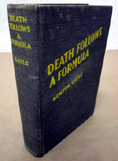
Their novels feature a wry British sleuth who
solves crimes in Britain, the United States,
and Puerto Rico, while occasionally referencing broader political
themes. No less a publisher than Scribner's
issued them; they received decent reviews, and were translated into Spanish
and Italian. Although they lack the psychological torture required to satisfy more recent
taste, they are still good reading — especially Murder at
28:10 for its ravaging hurricane in San Juan. About this book,
which involves the murder of a Roosevelt New Dealer bent
on Puerto Rican reform, the New Statesman and Nation said:
| Mr. Newton
Gayle has not only hit on a perfect novelty in the way of a setting
for a detective story, but he has risen to the occasion and writes
better than he ever wrote before; he even documents his hurricane
throughout with authentic weather charts supplied by the U.S.
Weather Bureau so that the reader can see from hour to hour what is
coming his way. |
Of special interest is the occasional use of bilingual dialogue, which
confronts readers with Spanish for the sake of literary verisimilitude, but
also for the Pan-American challenge of it. Beyond that, Lee's contribution of vivid
descriptions to the narrative is readily apparent, as seen in this passage about the
impending hurricane:
|
The waves were breaking now in turbulent mountains that rained occasional sleety
spray all about us. Streaks of dull sulphurous flame stained the horizon's gray bank.
The sultry air was charged with tension more psychological than electrical.
One felt a dull unbelieving wonder at the realization that beyond the sullen horizon
the wild whirling dervish of storm was headed toward us. Our palmy green island, prone
in its path, had no escape and no stay.
Between the brief squalls the air was heavy, inert. Velvety large-petalled mauve
flowers on an exuberant trellised vine barely stirred in the uncertain whiffs of
breeze that came shoreward. A starry white cloud of jessamine beside the door and
delicate rosy-lilac clusters twining with it, crisp and dainty, made
incongruous patterns of April against the menacing August sky.
"Dick!" breathed Cay, "take a good look at the garden before we go in. We may never
see it so beautiful again!"
Then unexpectedly, with a little crooning sound, she snatched up a pair of shears
from the garden-bench and sprang toward her cherished vines. Ruthlessly, even as Patria
and I exclaimed together in protest, she slashed through the thick twining stems
and tore down springing masses of fragile flowering branches. Not one did she leave.
And that act of vandalism accomplished, she turned toward us and said,
"Help me take in my flowers. At least, the wind shan't twist them up by their roots!” |
The distinctive cadences of Lee's prose, together with her characteristic use
of flower images to signify the goodness of nature, reveal her poetic voice. Guinness
had nothing like it. Earlier in her career as a writer, during the mid-1920s, she
had attempted to write an autobiographical novel; it was to be called Frontier
— "the frontier of life, of course," she said, "as well as the other thing,"
namely, her life in Oklahoma —
but it never came to fruition. She was essentially a poet,
not a novelist.
During the 1930s, her professional activities were, as
always, wide-ranging. In 1930, she started serving as a
permanent member of the Council of the Poetry Society of America.
From 1933 to 1939, she was literary and foreign news editor of
La democracia. Since 1932, she was a contributing editor
to Books Abroad, the worldly journal from Norman,
Oklahoma, as well as contributing editor to Equal Rights,
the weekly (until 1934), then semimonthly, magazine published by
the NWP. In 1937, she edited Art in Review, a special
retrospective issue of the University of Puerto Rico
Bulletin that celebrated a decade of artistic development in
Puerto Rico, which was published in December of that year.
In August 1939, on the campus of the University of Puerto
Rico, Lee addressed the biennial Congress of the World Federation
of Education Associations held there, at the unveiling of the
bronze plaque commemorating the centenary of Eugenio María de
Hostos, the Puerto Rican writer, patriot, and educational
reformer (founder of the modern educational systems in Chile, the
Dominican Republic, and Venezuela). The plaque for Hostos's
statue on the campus had been authorized by the Eighth
Pan-American Conference. At the ceremony by the statue where the
Congress delegates were gathered, Lee delivered her address which
focused on the international significance of Hostos as an
educator. It was an elegant and erudite speech that she began
with charm and humor in a retrospective look at the world in
1839, the year of Hostos's birth:
| In 1839 in the United States,
Van Buren was in the last year of his unpopular presidency and
the turbulent political campaign of 1840 was brewing; so that it
is highly improbable that it occurred to anyone that the really
significant event of that year in the States was the first
application of the screw propeller to an ocean
steamer. |
After reviewing Hostos's achievements and legacy, she ended on a
stirring note showing her capacity for rhetorical brilliance:
| In view of this tremendously
productive and inspiring life, it is not too much to say of
Eugenio María de Hostos, as he himself said of Hamlet, in his
famous essay, that he was "a moment of the human spirit"; not a
moment of gloom and vacillation, but a moment of resolution and
courage not to be extinguished even by the hazard of birth in an
impoverished sea-girt Caribbean colony, in that harassed and
threatening year 1839. |
Her ability to shine at such public appearances and
performances had grown over the years through her experience in a
range of different contexts.
The 1930s saw Lee rise to prominence throughout the Americas for her diverse literary
and political work. She had appeared in every edition of Who's
Who in America since 1928. She appeared in the first (1933–34) and second (1936–37)
editions of Quien es quien en Puerto Rico (Who's Who in Puerto Rico).
The 1939–40 edition of the
biographical dictionary, American Women (the official who's
who of the women of the nation), included the basic information about her, along
with a subtle revelation of her personality seen in the "hobby"
category, where she entered just one thing: "islands."
It is, moreover, noteworthy that the 1940 Federal Writers' Project publication, Puerto Rico:
A Guide to the Island of Boriquén, listed her among the important "contemporary
Puerto Rican writers" in its chapter on the island's cultural life, describing her
as "a continental American living in Puerto Rico" who had "gained her high reputation
as a poet on the mainland."
In April 1940, Holland's, The Magazine of the South published
a glowing feature about her titled "Muna Lee: Poet and Feminist."
She was at the time an active member of the Ibero-American
Institute of the University of Puerto Rico, and of the governing
council of the World Woman's Party founded by
Alice Paul. This newly-organized international feminist venture was made
urgent by the precarious position of women around the world; the
party was dedicated to preserving and extending equality for women,
and combating attempts in international treaties to take away their
rights to employment, among other injustices. In Holland's, in response
to the question about how she started writing poetry, Lee said:
| My real incentive to write poetry
was inherited from my mother, who published verse occasionally in
her girlhood and who had and has a poised and sensitive
appreciation of beauty in all its manifestations; from my father,
who was and is gifted with sympathy and discernment; from my
grandmother, who loved flowers and to whom flowers responded as to
no one else I've ever known. But whatever poetic gift I have has
also been fostered by every favoring environment: the beautiful
simplicity, dignity, and pride of Mississippi; the thrilling sweep
and color of the Indian Territory prairie; the heartening
friendliness of great cities, New York, Washington, Paris, Madrid;
the remoteness and completeness and intensity on this tropic island
[Puerto Rico] that has been a rich port to
me. |
Not mentioned was her lifelong and fierce inner need to gain,
through the act of creation, a sense of order in her life of
emotional extremes, and also to speak in public what only poetry
allows, the truth and beauty of things that she forever sought and
needed to articulate for her personal well-being.
At this time, Lee was playing a leading role in the planning and organization of a major literary event billed as the First Inter-American Writers' Conference of the University of Puerto Rico, to take place in the spring of the following year. This international gathering of writers was held during the course of ten days, in April 1941, at the university's campus in Río Piedras. Lee's encounter there with William Carlos Williams, who was an honored guest and speaker, was especially significant for both of them, since they would cross paths in the future about poetic matters of mutual concern, in particular those related to Latin American poetry in translation, and also his Puerto Rican roots.
This writers' conference aimed to stimulate an interest in writing among the students of the university (the public was also invited to attend), but its larger purpose was "to promote fuller understanding and mutual appreciation among the writers and intellectuals of the American Republics by bringing together a group of the outstanding writers of Latin America and the United States in an atmosphere of friendly cooperation and good will." Moreover, the conference embodied Lee’s personal Pan-American cause, as seen in the language of its publicity, for which she was responsible: "If the countries of the Western Hemisphere are to unite for the defense of their cultures and traditions, the success of their efforts will depend in large part upon the mutual understanding and esteem of the intellectuals of these countries."
In his featured lecture on poetic form, Williams emphasized that Latin America had much to offer the writers of the United States, and that its vital function was: "To introduce us to Spanish and Portuguese literature — pure and simple. And if to that literature, to make us familiar with its forms as contrasted with our own. For instance," he said, "What influence can Spanish have on us who speak a derivative of English in North America? To shake us free for a reconsideration of the poetic line."
Lee could not have been more pleased by Williams' appreciation of the literary genius of Latin America as well as his appeal for inter-American exchange among poets of the New World. In May she wrote him: "Ripples and phosphorescence still mark your Caribbean passage. You may be sure that Puerto Rico will not forget you and has very evidently taken you to her heart as her prodigal son."
Working for Pan-American Union
In the fall of 1941, Lee began a new phase in her career that would
span the rest of her life. When she was offered
a position as a cultural affairs specialist in the State
Department (she and Muñoz had just agreed to divorce), she moved to Washington with her two children and her
seventy-one-year-old mother who had joined her household. Her job was to confer daily
with ambassadors and ministers of Latin American countries,
arranging for exchange of literature, art, and films, and she was
instrumental in persuading artists and writers — Faulkner among
them — to go abroad as goodwill ambassadors for the United States.
Indeed, she would become a valued counselor at all official levels
in the State Department on matters related to Latin America.
In a news article about Lee headlined "Pan-American Literary
Ties Urged on U.S.," which appeared in the New York Herald
Tribune on November 30, 1941, she stressed the goodwill value of
translation, saying that there was "no better way to develop
friendship between the United States and Latin America than to
translate and publish the literature of each region for the other."
She briefly discussed her current work as a poetry translator, and
added, "To the best of my belief, Latin-American poets are equal to
any in the world." The article went on to describe her recent
arrival in Washington and her position in the State Department,
ostensibly just for a year's sabbatical leave.
Lee's government work was initially part of the broadening of
Roosevelt's Good Neighbor Policy during the late 1930s in response
to the gathering of war clouds in Europe and the Far East.
Washington then stepped up its program of cultural exchange to help
ensure the hemispheric solidarity of the Americas.
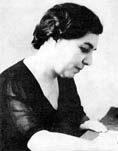 In addition to her new duties and responsibilities at the State Department, Lee was very much involved with
New Directions's forthcoming publication of the bilingual Anthology of Contemporary Latin-American Poetry.
The book's editor, Dudley Fitts, had invited her to contribute translations just before she left San Juan for Washington.
The 667-page anthology would be a landmark publication. Nothing as comprehensive had appeared in the
so-called modern era (cf. Alice Stone Blackwell's 1929 anthology, Some Spanish-American Poets), and, regrettably, nothing like it would appear for nearly three decades
—
nothing that could give
the English-language audience a decent view of the vast range of poetic genius in South America.
In addition to her new duties and responsibilities at the State Department, Lee was very much involved with
New Directions's forthcoming publication of the bilingual Anthology of Contemporary Latin-American Poetry.
The book's editor, Dudley Fitts, had invited her to contribute translations just before she left San Juan for Washington.
The 667-page anthology would be a landmark publication. Nothing as comprehensive had appeared in the
so-called modern era (cf. Alice Stone Blackwell's 1929 anthology, Some Spanish-American Poets), and, regrettably, nothing like it would appear for nearly three decades
—
nothing that could give
the English-language audience a decent view of the vast range of poetic genius in South America.
The invitation to contribute to this anthology appealed to Lee not only because it would help further the
Pan-American cultural relations to which she was dedicated, but also because she could engage herself with poetry,
and pursue that passionate need of hers. The group of sixteen translators assembled for the book included John Peale Bishop,
Angel Flores, Langston Hughes, H. R. Hays, Robert Fitzgerald, Rolfe Humphries, Lloyd Mallan, and Fitts himself, among
others.
In September 1941, Fitts had asked Lee for help in a letter that became part of a lively yearlong correspondence
between the two of them about this book project. He was "hard pressed for translators,"
to which she replied: "Why should you be? I'm here, and translating Spanish for my own pleasure has been my
avocation for a long time." This was happy music to his ears. He valued her translations more than
those produced by most of the other translators working for him; he "had to rewrite at least two thirds of all the material" they
sent him.
Fitts wanted translations that had a "maximum of literal fidelity" — the translations could also be poems in their own right,
but that was of secondary importance to him. In Lee he found a model translator whose renderings were both literal and
poetic. "I can't tell you," he wrote to her in early October, "how strange and how refreshing it was to read your pieces and
find that only by hairsplitting could I make any objections at all. And for that reason I want very much to send you some
more things […]." She responded: "By all means send me more things
—
send me whatever you like. I like
translating."
Lee worked on making translations for him whenever she could find the time. By the end of October, she sent him a
group of poems that, he said, "couldn't have been better planned for this anthology!" These poems included
specific translations he requested, as well as other translations she offered on her own (e.g., Vallejo's "Dregs"). He told
her: "Every one is right bang in the period. You should be getting out this book, not I
—
and yet I could hardly wish that you
were, for it is mostly an uninterrupted and highly ungrateful headache."
In mid-November, just as Lee was settling into her new life in Washington, she wrote to Fitts: "Naturally, work at the
State Department will not interfere with my translating. The thing is — it just occurs to me — that someday this anthology of
yours
will be finished. And then what shall I do with the spare time that I never knew I had until it irrupted on my horizon?"
She also contributed to the writing of the biographical notes about the poets represented in the anthology. The book
was finally done by the summer of 1942, and was published in the fall of that year.
Lee contributed some thirty-seven different translations
representing twenty-two poets from all over Latin America. Some of
her work had been done previously, but she made many of her
translations especially for this book project. Among the poets to
whom she gave an English-speaking voice were Chile's Gabriela
Mistral, Peru's César Vallejo, Argentina's Rafael Alberto Arrieta,
Cuba's Eugenio Florit, Uruguay's Ildefonso Pereda Valdés, Mexico's
Jaime Torres Bodet, Venezuela's Antonio Spinetti Dini, Guatemala's
Rafael Arévalo Martínez, Honduras's Constantino Suasnavar, Costa
Rica's Asdrúbal Villalobos, Ecuador's Jorge Carrera Andrade, and
Puerto Rico's Luis Muñoz Marín [second edition].
Lee's translation of Muñoz's "Pamphlet" and "Proletarians,"
written in his youth, offered readers the poetic background of his
current political work. In her translation of Vallejo's "Dregs,"
she re-created his complex images that sometimes work on two or even three levels,
and she showed the poetic power of the Peruvian, whose profoundly humanitarian voice
was little known at the time to English-language readers:
This afternoon it is raining as never
before, and I,
my heart, have no desire to live.
This afternoon is sweet. Why shouldn't it be?
It is dressed in grace and sorrow; dressed like a woman.
It is raining this afternoon in Lima. And I remember
the cruel caverns of my ingratitude;
my block of ice crushing her poppy,
stronger than her "Don't be like this!"
My violent black flowers; and the barbarous
and enormous stoning; and the glacial interval.
And the silence of her dignity will mark
in burning oils the final period.
And so this afternoon, as never before, I go
with this owl, with this heart […] |
Her rendering of Mistral's "The Little Girl That Lost a Finger"
offered the very different voice of the woman who in 1945 would
become Latin America's first Nobel Laureate in Literature "for her
lyric poetry which, inspired by powerful emotions, has made her
name a symbol of the idealistic aspirations of the entire Latin
American world":
And a clam caught my little finger,
and the clam fell into the sand,
and the sand was swallowed by the sea,
and the whaler caught it in the sea,
and the whaler arrived at Gibraltar,
and in Gibraltar the fishermen sing:
"News of the earth we drag up from the sea,
news of a little girl's finger:
let her who lost it come get it!"
Give me a boat to go fetch it,
and for the boat give me a captain,
for the captain give me wages,
and for his wages let him ask for the city:
Marseilles with towers and squares and boats,
in all the wide world the finest city,
which won't be lovely with a little girl
that the sea robbed of her finger,
and that the whalers chant for like town criers,
and that they're waiting for on Gibraltar
… |
Most impressive were Lee's nine translations of poems by Carrera
Andrade, who was (and still is) considered not only the premier
poet of Ecuador, but one of the foremost Spanish-language poets of
the century. Her renderings of his work formed the body of the
anthology's opening section, and included his "Sierra":
Corn hangs from the rafters
by its canary wings.
Little guinea-pigs
bewilder the illiterate silence
with sparrow twitter and dove coo.
There is a mute race through the hut
when the wind pushes against the door.
The angry mountain
raises its dark umbrella of cloud
lightning-ribbed.
Francisco, Martín, Juan
working in the farm on the hill
must have been caught by the storm.
A downpour of birds
falls chirping on the sown fields. |
The poetic success of her many different translations stems
from the rare combination of her near-native fluency in Spanish,
her intimacy with Latin America and its literature, her critical
astuteness, her knowledge of contemporary North American poetry,
and her creative skills as a poet in English.
Among the grateful readers of her Carrera Andrade in particular was William Carlos Williams. She had sent him a
group of her translations in July 1942, before the anthology's publication, and he responded enthusiastically with
the following note:
| Let me tell you how much pleasure you gave me by your translations of the work of our Ecuadorean poet […]. I don't
know when I have had so clear a pleasure, so unaffected by the torments of mind which are today our daily bread. The images
are as you say so extraordinarily clear, so related to the primitive that I think I am seeing as an aborigine saw and sharing
that lost view of the world. It's a sad pleasure but a great one. |
Williams concluded with these words of respect for Lee's work: "Thank you for
introducing me to Andrade. We all need to know each other better, we need it badly.
We need it more than anything else in the world" [entire letter].
The subsequent edition of the anthology, published in 1947, would include the
addition of a single poem — "Song to the Glory of the Sky of America" (1942) —
by Uruguayan poet-physician Emilio Oribe, translated by Lee with lyric brilliance,
that became the book's final word and called for
Pan-American harmony:
"A poem from grey barrens tearing free / Where the North Pole hypnotizes the Pole Star, / Rainbow-like above the
crystal of twenty countries arches far, / Then again plunges strong / Amid icebergs of the South into the sea."
Translating Ecuador's Premier Poet
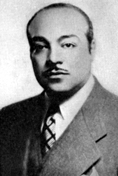 The translations of Carrera Andrade that Lee contributed to the
New Directions anthology were part of another book project on which
she was working at the time. She was translating his País
secreto (Secret Country), a book of poems originally published
in 1940. A diplomat as well as a writer, he had started serving
as the Consul General of Ecuador that year in San Francisco, and
Stanford University Press had expressed an interest in publishing
her translation of this book. The Office of Pan-American Relations
of Stanford's Hoover Library on War, Revolution and Peace (now
Hoover Institution) supported this publication initiative.
The translations of Carrera Andrade that Lee contributed to the
New Directions anthology were part of another book project on which
she was working at the time. She was translating his País
secreto (Secret Country), a book of poems originally published
in 1940. A diplomat as well as a writer, he had started serving
as the Consul General of Ecuador that year in San Francisco, and
Stanford University Press had expressed an interest in publishing
her translation of this book. The Office of Pan-American Relations
of Stanford's Hoover Library on War, Revolution and Peace (now
Hoover Institution) supported this publication initiative.
Lee and Carrera Andrade started corresponding soon after his arrival in San Francisco,
while she was still living in Puerto Rico. It was an exchange of letters filled with mutual admiration and
respect. He thought her translations of his poetry were "unsurpassable" (insuperables), and
encouraged her to translate his work. They often discussed the ideas behind his images, in order
to clarify them for her translations. Concerning any confusion caused by what he called his "poor images"
(pobres imágenes), he told her that he trusted in "the brilliant insight of Muna Lee to make them
beautiful" (la penetración luminosa de Muna Lee para su
embellecimiento) in English.
In the February 1942 issue of Poetry, Lee published a
review of his Registro del mundo (Record of the World), a
new anthology of his poetry written between 1922 and 1939. Despite
his great literary stature, no collection of his poems was yet
available in English translation; all that had appeared in book form so far was a slim volume
presenting a single long poem, "Canto al puente de Oakland," which
Stanford's Hoover Library published in 1941 in a bilingual edition titled To the
Bay Bridge, translated by Eleanor Turnbull.
For Carrera Andrade, poetry was the exaltation of human hope.
By experimenting with poetic form, he sought the most effective
means of conveying the stormy experience of poetic inspiration.
His work is characterized by objective yet emotional descriptions
of physical objects, simple vocabulary, and brilliant metaphorical
images; and he often treats social themes. In her review, Lee
says: "All his poetry has its own accent, its own freshness; and
most of its images — it blooms profusely with images — are set
down with the shrewdness and the sagacity of a peasant or a child."
Elaborating on his individual style, she adds:
| For the past ten years [… he]
has been what Latin American critics love to denote a poeta de
vanguardia [vanguard poet], though in him successful
experimentation with new rhythms has never meant a break with the
traditional rhyme and assonance which he handles so deftly and to
which he returns so often. Sometimes intricately patterned,
sometimes simple as folksong, his poems are usually brief, terse,
imagistic — always with a lovely play of echoes for the eye as
well as for the ear — and they frequently show a most un-Latin
delight in scents and sounds and textures of the countryside.
Essentially vigorous, vivacious, and authentic, they not only
reveal but impart a freshened vision of the
world. |
Lee offers as examples of his work her translations of two poems that would be
included in Secret Country, "Nameless District" and "Biography for
Use of the Birds," which appear in the anthology (they were not included in
País secreto, but were added to the book in English, as a consequence of her
telling him: "I love these poems so much that it is hard to bear their omission!").
About "Nameless District," she says that it shows Carrera Andrade at his best as a
"single-hearted regional poet":
In my district there are groups of houses
and cattle,
sacks of cloud that pour forth silver kernels of sleet,
a sky that suddenly opens and closes its showcases,
pumpkins heavy with dream that drowse by the roadside,
a torrent emerging from a counterfeiter's cave,
morning vegetables traveling to town on muleback,
all the insects escaped from the multiplication table,
and air that at every hour fondles the fruit.
In my district the flowers offer up in their tiny open hands
or in their little close-shut fists,
the essence of earth's silence […] |
Around the time of the publication of this review, Carrera Andrade asked
John Peale Bishop to write an introduction to Lee's
translation of his book. In a letter to fellow patrician poet Allen Tate, Bishop
mentioned this project, and said he thought that she
"was one of the best translators we discovered for the Fitts anthology." He was
working as publications director in the New
York office of the Council of National Defense, in the section dedicated to
inter-American cultural affairs,
which had supported the New Directions publication.
Lee was very pleased about Bishop's offer to contribute the introduction
to Secret Country. She told him in a letter written in January 1943 that it gave
her "deep satisfaction
to know" he was going to write it: "I believe with you that his [Carrera Andrade's]
problems are the problems of us all. I believe also that no
one comprehends those problems better than you. It will add a fresh delight to the
always quickening attention with which I re-read even the most familiar of his poems to have this interpretation of his work as companion in the
reading." About her work, she explained, "I think I have said in English in every case what he has said in Spanish,
and I believe that even in the obscurest cases I have glimpsed his original meaning." A
few years later,
Secret Country would be published by Macmillan, the publisher of her Sea-Change.
During this period, still speaking out for the betterment of women throughout the
Americas, Lee addressed the 1943 Pan American Day Conference on the Contribution of Women to Hemisphere
Solidarity. This gathering was sponsored jointly by the New York Times, National Council
of Women, and Pan American Women's Association, and was held at the New York Times Hall
in New York. She talked about the war-charged significance of the Caribbean countries,
and the current role of women in the Caribbean, "where again the Greater and the Lesser
Antilles, the Leeward and the Westward Isles, are outposts, sentries and bastions of
the Americas." She argued that "women in the Caribbean area are, politically and
educationally speaking, among the most progressive in our hemisphere." And she
maintained:
|
Through the difficult days of colonization when they contributed as fully as their
husbands, sons and brothers to the development of the New World; through the heroic days
of the Era of Independence when they suffered and often died for the freedom they
cherished; in the wake of pirate raids and of hurricanes; in times of prosperity and through
long periods of distress; the women of the Caribbean have proved time and time again
their patriotism, courage and devotion. |
Lee cited numerous historical facts to support her claims, and concluded her address
with a vision of Caribbean women contributing much to the war effort and actively
engaged in social action in defense of the Americas:
|
The future and continuing contributions of the Caribbean woman will include many
[social and war-related] services, I believe, both within each country and beyond its
borders wherever the need and desire for cooperation exist. A citizen of the hemisphere,
she knows that what is basic in our lands is not the seas or the rivers or the mountains
that seem to separate us, but the conviction of equality and will to freedom, our
common democratic faith and heritage, that hold us together. |
Lee's remarks appeared five days later in the Puerto Rico World Journal, the
San Juan daily English-language
newspaper that published a regular column — "‘M. L.’ in Washington" —
that she contributed to it for a brief period during the early 1940s.
Doing The American Story
In 1943, Lee proposed a creative Pan-American project to poet
Archibald MacLeish, then serving in Washington as the Librarian of
Congress. She wanted to collaborate with him on writing a series of
programs for NBC radio's new Inter-American University of the Air;
the NBC Inter-American University of the Air was the first
endeavor in network history in the United States to provide
instruction in a variety of subjects, correlated with existing
courses in universities and colleges throughout the nation.
MacLeish had developed over the years a strong interest in Latin America.
In his 1939 "Remarks on the Occasion of the Dedication of the
Hispanic Room in the Library of Congress," he made the following
comment while making reference to the importance of the Spanish
chronicler Bernal Díaz del Castillo:
| Some twelve years ago in a
Paris library I came upon a copy of Bernal Díaz's True
History of the Conquest of New Spain. There, in that still
living, still human, still sharply breathing and believable
history of Mexico, it seemed to me that I understood for the
first time the central American experience — the experience
which is American because it can be nothing else — the
experience of all those who, of whatever tongue, are truly
American — the experience of the journey westward from the
sea into the unknown and dangerous country beyond which lies
the rich and lovely city for which men
hope. |
MacLeish's vision of America was very much in sync with Lee's.
She too had come to understand the Pan-American implications of the
"American" experience. Thus he was receptive when she came to him
with the idea for doing what became American Story, a
series of ten scripts broadcast on NBC radio in February, March,
and April 1944. Its underlying theme was that of the early
discoveries along all the American coasts.
Lee said the series aimed "to give the peoples of all the American Republics a
sense of the community of the American experience by introducing them through the
broadcasts to the fundamental and authentic expressions which make up the American
record as history and as literature." She explained:
| The initial series dealt with the discoverers, the
men of the several European countries who made the first landfalls in the New World,
and with the discovered, those who, unknowing and unknown, awaited the coming of the
westward ships. It included the accounts of the new lands, and of the animals and birds
and trees and flowers and aborigines as they appeared to the voyagers in dazzling
newness. Firsthand accounts of the actual settlement of the land, from the St. Lawrence
to the River Plate, and of the nature of the settlers, as they seemed to themselves and
to their companions, shaped separate broadcasts; as did contemporary accounts of life in
the settlements; the relation between the New World and the Old, their mutual impact;
and the chronicle in all our lands and languages of the undefined but ever advancing
frontier against strangeness. The later colonial experience; the spontaneous and
continent-wide impulse toward independence; and the wars of freedom were also evoked
in the words of those who made the story: the words sometimes of leaders, but more often
of the American — whether by the Mississippi, the Rio Grande, or the Amazon — who
was part
of the persistent, courageous anonymous horde that pierced the forests, and crossed the
plains, and voyaged the perilous rivers, and fought the battles, and contributed to the
fragmentary but perfectly coherent record a letter or a passage in a diary or a snatch
of song, or a desperate message out of an hour of utmost need. |
Expressing in poetic language the spirit of Pan-Americanism she shared with
MacLeish, she said the American Story broadcasts were "based on the belief that
there is in all our lands and all our natures, underneath the differences and
variations, a core that is essentially American and identical; that the experience of
being born on the free soil of America and growing into the free American air gives a
shape to the American mind as distinctive as the shape of the live-oak leaf, and as
unlike the European oak's."
Lee maintained that whether the discoveries along the American coasts
were made by the
Spanish and Portuguese or by the English and Dutch and
Scandinavians, the pattern was similar, and the struggles with the
native peoples in the interior came about in much the same way.
She did all the research for the broadcasts, and MacLeish stitched
the material together. In the first script, he said the purpose of the
broadcasts was "to bring together from the
ancient chronicles, the narratives, the letters, from the pages
written by those who saw with their own eyes and were part of it,
the American record — the record common to all of us who are
American, of whatever American country and whatever tongue
— the record of the American experience common to us all."
In addition to research, Lee's contribution included making
translations of all documentary texts in Spanish, Portuguese, or
French that were not available in English. She also wrote the
handbook that accompanied the series, recounting the stories of
diverse figures in the European discovery of America; this
handbook, American Story: Historical Broadcast Series of the
NBC Inter-American University of the Air, was published by
Columbia University Press in 1944. That same year, MacLeish
published the scripts in a collection titled The American Story;
Ten Broadcasts, which he dedicated to her:
To
MUNA LEE
A
POET OF THE AMERICAS
Indeed, he credited her with the success of the series,
praising her as "a poet […] a sound scholar, a mistress of tongues,
and a profound believer in a cause." And he told her in a letter:
"Thanks to you — not to me at all, but to you — The American
Story has really begun to do the work you and I wanted it to
do."
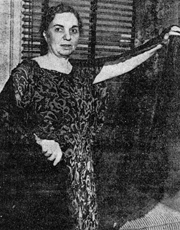
With her distinguished credentials as an envoy of the Americas, Lee was widely sought after as a speaker. Her
talks addressed different aspects of inter-American relations. In May 1944, she gave one such talk in Columbus,
Ohio, as guest speaker at the annual dinner of the local chapter of Theta Sigma Phi, the honorary journalism sorority
(now Association for Women in Communications). The title of her talk was "A North American Looks South."
She started by saying that her early education had led her to believe "American history was a phrase exclusively
descriptive of the United States. Fortunately, though," she added, "there are many roads leading from such a morass
of ignorance as all that, and the first one that opened to me was through language." The written and the spoken word,
she stressed, offered a direct way to understand the other American nations. She talked
about books as "windows," and recommended
Virginia Prewett's The Americas and Tomorrow, Blair Niles's Passengers to Mexico, and the soon-to-be published
American Story.
Citing various examples of similarities between the Americas in geography, history, and art, through the use of
both North and South American literature, Lee concluded her talk with the remark, "When I look south through
whatever window, I see what I believe any citizen of any of the southern republics sees when he looks north:
America." She then read several of her poems with a Caribbean setting, and three of her translations of poems by
Carrera Andrade.
Also in 1944, Lee published Pioneers of Puerto Rico, a
children's book for which MacLeish wrote the
introduction. This work sketches the history of Puerto Rico from
colonial times to the poverty-ridden present of Muñoz Marín's
efforts to readjust the island's economy. The book was part of the
publisher's "New World Neighbors" series,
and was designed to give children of elementary school age, in
story-book fashion, a panoramic view of the history and spirit of
Puerto Rico. That same year, her
translation of an essay on the challenges of Pan-Americanism,
written by the celebrated Venezuelan writer and diplomat, Mariano Picón Salas,
was published by the Pan American Union's Division of Intellectual Cooperation
as a book titled On Being Good Neighbors.
In August 1945, Puerto Rico's major newspaper, El mundo, published a glowing appreciation of Lee's Pioneers of Puerto Rico, as well as her life and other literary work. It was, on the whole, a very positive and flattering editorial about her. But a remark about her relationship with Puerto Rico, now that she was living in Washington, moved her to write a letter to the editor to correct what she acknowledged was a detail that might appear insignificant, but was, nevertheless, of utmost importance to her:
| Yo no pertenezco, como indica el editorial, al grupo de personas quienes, luego de haber convivido con los puertorriqeños un tiempo, han abandonado su suelo. Muy al contrario, soy una para quien durante más de cuarto de siglo Puerto Rico ha sido, y sigue siendo, tierra y hogar. Mis dos hijos y mi esposo, mi querida mamá doña Amalia Marín de Muñoz Rivera, mi nuera, mis tíos políticos, y las amistades de más de media vida, son lazos entrañables. Por esta razón, a pesar de seguir fuera de la Isla durante la época de crisis mundial, mientras el Gobierno Federal puede hacer algún uso dentro de su gran tarea del poco que yo puedo aportarle, no he dejado de tener tanto mi residencia como mis afectos más profundos radicados perdurablemente en Puerto Rico.
[I don't belong, as the editorial states, to the group of people who, after having lived together with
Puerto Ricans for a while, have abandoned their soil. Much to the contrary, I am someone for whom during more than a
quarter century Puerto Rico has been, and continues being, hearth and home. My two children and my husband, my
dear mother Doña Amalia Marín de Muñoz Rivera, my daughter-in-law, my uncles and aunts by marriage, and the friendships
of more than half a life, are intimate ties. For this reason, despite still being away from the Island during the period
of world crisis, while the Federal Government could make some use in its great task of the little that I can contribute
to it, I haven't stopped keeping my residence as well as my deepest affections located forever in Puerto Rico. — Tr. JC] |
Lee had long ago become Puerto Rican in her heart. She would feel this way for the rest of her life,
even more so with the births of her grandchildren, and the Island would continue to be at the center of her life.
 Adding
yet another facet to her multi-faceted career, in 1945, Lee
started to serve a four-year term as president of the Washington-based
Society of
Woman Geographers. She was a founding member, and had served on its executive council
in the years just prior to her presidency. Established in 1925
by four exceptionally accomplished women in New York (Marguerite
Harrison, Blair Niles, Gertrude Shelby, and Gertrude Emerson Sen) — all
recognized explorers — the society had been created to bring together
women, like Lee, who shared ambitions and interests in unusual world
exploration and achievements. No women's organization then existed
for the sharing of worldwide experiences, the exchange of knowledge
derived from field work, and the encouragement of women pursuing
geographical exploration and research.
Adding
yet another facet to her multi-faceted career, in 1945, Lee
started to serve a four-year term as president of the Washington-based
Society of
Woman Geographers. She was a founding member, and had served on its executive council
in the years just prior to her presidency. Established in 1925
by four exceptionally accomplished women in New York (Marguerite
Harrison, Blair Niles, Gertrude Shelby, and Gertrude Emerson Sen) — all
recognized explorers — the society had been created to bring together
women, like Lee, who shared ambitions and interests in unusual world
exploration and achievements. No women's organization then existed
for the sharing of worldwide experiences, the exchange of knowledge
derived from field work, and the encouragement of women pursuing
geographical exploration and research.
The Society of Woman Geographers filled this need. Its name was intended to mean "geographer" in the
broadest sense to include such allied disciplines as anthropology,
geology, biology, archaeology, oceanography, and ecology.
Specialized aspects of the arts rounded out the broad spectrum of
worldwide interests and professional activities of the society's
members. The membership included (as it still does) women "explorers at heart"
whose work involved extensive travel in the investigations of little-known
or unique places, peoples, or things in the world. Lee's long involvement with this
organization stemmed from her diverse interests in the Americas, natural history,
feminism, and the arts.
When Secret Country finally appeared in 1946, critics
responded favorably and excitedly to it. This publication, which
included a poetic, critically astute
introduction by Bishop, was the first
major translation of Carrera Andrade's poetry (not until 1972 would
another be published, belatedly, in the United States).
M. L. Rosenthal gave it high praise in the New York Herald Tribune, saying "Jorge Carrera Andrade is a
poet for Americans to love and study" — "he thinks in images, and surely he must always have at hand a thousand
simple, beautiful appropriate images for every experience known to man." Rosenthal
stressed that with "an imagination so muscular and finely trained that it can handle any grouping of
sense-effects and ideas without straining," the Ecuadorian poet "puts to shame
much of our North American
groaning after impossible images to symbolize inadequate experience."
In the
New York Times, Babette Deutsch reviewed the book in glowing
terms:
| The poems are not political
or programmatic, but they are, what is more important,
profoundly humane. And whether they speak of strange
landscapes or intimate interiors, of "The Life of the Cricket"
or in "Defense of Sunday," of the miracles of physical love or
of the metaphysics of solitude, they speak with an immediacy
and an inwardness that can be paralleled only in the work of
such men as Rilke, Lorca and Pasternak. With these three so
various poets Señor Carrera Andrade shares an acute insight
into things that makes his poems, even at second hand, an
unlooked-for treasure. |
About Lee's translations, she said that "the poet himself was
correct in describing them as 'exceptionally good and very
beautiful.'" The Yale Review said that "even where she has
departed slightly from the actual words used she has rendered the
text with fidelity and poetry."
More high praise of Lee's translation came from Donald Walsh. In December 1946, at the annual meeting of the American Association of Teachers of Spanish and Portuguese, held in Washington, Walsh delivered a paper in which he reviewed the year's publishing activity in terms of Spanish American literature, and he closed with the following statement: "I have not included in this paper translations from Spanish American literature, but I must mention one book that is a literary event in both languages: Muna Lee's Secret Country, translations of thirty poems of Jorge Carrera Andrade, Ecuador's most famous poet. […] Muna Lee has translated him with perfect understanding and with a poetic skill that matches, and at times exceeds, that of the poet himself. This slender volume must be ranked with that small group of translations that are true re-creations of great literature in a new language."
Praising her work in a letter to her, MacLeish said: "Knowing how pitifully inadequate my grasp
— the word 'command' won't come — of Spanish is, you will know that I can speak of them only as poems
in themselves. Speaking of them so, there is no question whatever of their authenticity. If your poet is as good as
you make him he is more than remarkable. He is what one has always hoped to find." More praise of
Secret Country came later from another poet friend, Carl Sandburg, whom she had first met years ago
in the offices of Poetry in Chicago. "Dear Muna," he wrote, "Tell Andrade I have read him in Spanish once & your
translations six times & that as writers I feel we are brothers" — he was his "brother in the poetry quest
a little more than any other in this hemisphere."
Lee's artistry as a translator can be seen in her translation of
Carrera Andrade's "Biography for the Use of the Birds," in which,
as she had said in her review of his Registro del mundo, he
voices "that sense […] of being carried too fast and
too far by the shifting currents of the world":
I was born in the century of the death of
the rose
when the motor had already driven out the angels.
Quito watched the last stagecoach roll,
and at its passing the trees ran by in good order,
and the hedges and houses of the new parishes,
on the threshold of the country
where slow cows were ruminating the silence
and the wind spurred its swift horses.
My mother, clothed in the setting sun,
put away her youth in a deep guitar,
and only on certain evenings would she show it to her children,
sheathed in music, light, and words.
I loved the hydrography of the rain,
the yellow fleas on the apple tree,
and the toads that would sound from time to time
their thick wooden bells.
[. . . . . . . . . . . . . . . . . . . . . . . . . . . .]
The valley was there with its farms
where dawn touched off its trickle of roosters,
and westward was the land where the sugarcane
waved its peaceful banner, and the cacao
held close in a coffer its secret fortune,
and the pineapple girded on her fragrant cuirass,
the nude banana her silken tunic.
It has all passed in successive waves,
as the vain foam-figures pass.
The years go without haste entangling their lichens,
and memory is scarcely a water-lily
that lifts between two waters
its drowned face.
The guitar is only a coffin for songs,
and the head-wounded cock laments.
All the angels of the earth have emigrated,
even the dark angel of the cacao tree. |
This particular version shows the polishing work she would do in the
process of making a translation, in her effort to re-create the
poetic quality of the original Spanish. The rendering she had
presented in her review was rougher, its language not yet fully naturalized
in English, as seen in the poem's opening lines:
I was born in the century when the rose
became defunct,
when the motor had frightened off the angels.
Quito saw the last diligence roll by
and after it all orderly ran the trees,
the fences, and the houses in new developments
where the lazy cows ruminated the silence
and the wind spurred its swift horses
[…] |
Very much a process writer in general, Lee knew only too well
that faithful and poetic translations require time to make, in
particular when working with the deceptively simple, yet complex,
language of poets like Carrera Andrade. She understood that the
act of translation is at once critical and creative. Although she
could not replicate the music of his Spanish, she also understood
that for a translation to have literary value, it has to be
composed as if a poem written in English with verbal music of its
own, true to the "sound" of the original.
To her, translation meant "continual experiment, continual attempt," as she explained to
Bishop in her correspondence with him. "It is all nonsense to say that the way of the translator is hard," she added,
"it is difficult sometimes, as mountain climbing often is, but it has the same delights and rewards."
Lee's demanding job at the State Department kept her busy both
in and out of the office. Her public speaking, as always, was a major
part of it, as shown by the notice of her recent lectures in
the April 1946 issue of The
Americas, a new quarterly review of inter-American cultural
history (to which she contributed
numerous book reviews over the years):
| Miss Muna Lee, of the American
Republics Area Division of the Department of State, has just
completed an extensive series of lectures on various Latin-American
subjects. Her lectures included: "What Do the Other American
Republics Expect of the United States," at the Sunday Evening
Forum, Essex, Conn.; "Cultural Relations Between Puerto Rico and
the U.S.," at the World Fellowship Committee meeting, Washington,
D.C.; "Puerto Rico: An Example of Cooperation," at the Zonta Club,
Washington, D.C.; "What Do the Other American Republics Expect of
the United States," at the Kiwanis Club, Cumberland, Md.; "Women in
the Other American Republics," at the Business and Professional
Women's Club, Alexandria, Va.; "Cultural Cooperation Between the
Americas," at Ginter Park Women's Club, Richmond, Va.; "Vocational
Opportunities for Women in Latin America," at the Altrusa Club,
Atlantic City, N.J.; Miss Lee has also given three lectures at an
institute on Latin American affairs held at the State Teachers
College, Farmville, Va. |
She spoke effectively and engagingly on each occasion, as indicated by the
letters of gratitude she received. "Miss Lee was delightful" and "the best
program we have had" were typical of the comments made by her audiences, which
these letters relayed to her. Although known in public as Miss Muna Lee, she and Muñoz
were still legally married, but that would soon change.
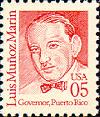 On November 15, 1946, after more than a decade of estrangement and separation,
they finally were divorced legally. The following day he married Mendoza, with whom
he had been living and with whom he had already fathered two children. His marriage
to her would have bitter implications for Lee. Soon to be Puerto Rico's first lady, Mendoza made mention of Lee's name taboo
in Puerto Rico, motivated by both jealousy and political image-consciousness;
she did not want the public image of her husband — as well as hers — to be sullied in any way.
On November 15, 1946, after more than a decade of estrangement and separation,
they finally were divorced legally. The following day he married Mendoza, with whom
he had been living and with whom he had already fathered two children. His marriage
to her would have bitter implications for Lee. Soon to be Puerto Rico's first lady, Mendoza made mention of Lee's name taboo
in Puerto Rico, motivated by both jealousy and political image-consciousness;
she did not want the public image of her husband — as well as hers — to be sullied in any way.
In 1948, he would become Puerto Rico's first elected governor, serving four terms for a total of sixteen years and
establishing his place in history as the "father of the Commonwealth of Puerto Rico."
Attention
paid to his relationship with his first wife could be painfully
embarrassing for both him and Mendoza. After all,
Catholicism, the dominant faith in Puerto Rico, frowned heavily on divorce,
with the attitude that an absolute divorce can never occur, at
least after a marriage has been consummated. But more than that and more than
his previous adulterous relationship with her that more or less was socially acceptable,
Mendoza needed to erase Lee's name from public memory in order to rewrite history
and obscure her own adultery as a married woman (with two young children from this first marriage) living with Muñoz.
That behavior was not acceptable in Puerto Rico.
Even though Lee's marriage
to Muñoz had dissolved long before their actual divorce
— a fact she had come to accept — and the emotional pain she had
endured was no longer a living reality of hers, the legal process
and event must have struck a sad chord in her heart in which love,
for the second time, had been "like a hangman." Now, at the age of
51, she was in every way Miss Muna Lee again.
Three days after the divorce proceedings were completed, Lee sent a letter to her daughter, Munita, in
which she explained: "I really mind less than I had expected. In a sense it is a relief, as anything definite and above
all definitive must be, in comparison with incompletion, tenuousness and uncertainty." Lee did not want her daughter to
feel "too badly" that her marriage to her father had been terminated legally. Moreover, in keeping with the loving person she
was, she told her: "And don't stop being friends with your father. He wants your love, and needs it, and he has
always loved you dearly."
The following year, Lee published The Cultural Approach:
Another Way in International Relations, co-authored with Ruth
Emily McMurry, who also had long experience in the field of
cultural relations. MacLeish wrote the cogent introduction. This
publication would be the last book of Lee's own writing that she
published in her lifetime (it would be reprinted in 1972 by
Kennikat Press). It documents the efforts of various
nations to promote cultural and intellectual exchange. Like
McMurry, she had long been deeply concerned with familiarizing
cultural output across national borders, believing that only
through knowledge of each other can diverse peoples manage amicable
relations.
In The Cultural Approach, Lee and McMurry provide a
summary of the official information about bilateral long-range
programs of cultural relations as carried on since 1900 by some ten
countries, France, Germany, Japan, USSR, Great Britain, four
republics of Latin America, and the United States. Writing in the
aftermath of the Second World War, the authors conclude:
| We may say that the peoples
throughout the world seem agreed upon the importance of
mobilizing those forces which give promise of building trust
and confidence among nations. In a world torn by diverse and
conflicting political and social philosophies, it is difficult
to find middle ground. Admittedly government programs of
cultural relations abroad have been used as instruments of
aggression. Such programs are dangerous to the freedom-loving
peoples of the world, unless they are understood and unless
adequate measures are taken to offset them. On the other
hand, they have been used by some countries as measures for
creating a better atmosphere of mutually beneficial
cooperation among nations. |
The book's broader significance at the time of its original
publication was its implication that the entire problem of the
conduct of foreign affairs urgently required re-examination.
The years immediately after the war would see the demise of the old Pan-American movement and
the rise of the United States as a post-war leader and protagonist of the Cold War.
Lee’s work with the State Department continued, and while culture had become
significant to U.S. foreign policy, she was never complicit in the covert propaganda
wars to be waged in the fifties and sixties. She would never willingly involve herself with
programs of cultural relations used as "instruments of aggression." Always noble and sincere,
while open-eyed, she remained true to her humanistic Pan-Americanism throughout the coming years.
In April 1947, Lee made a return trip to Mississippi to speak at
Blue Mountain College for the revival of its Southern Literary
Festival, which had been suspended during the war. Five years
before, she had made her first return trip — after a "lifetime of
absence" — to speak at Hinds Community College, in her hometown of
Raymond. At Blue Mountain, she gave a talk on writing titled
"Poetry Every Day," in which she professed:
| There is nothing to be afraid of
in the name of poetry, though it is in all languages and in all
ages a name for wisdom and beauty. Whether we know it or not,
poetry is a part of the everyday life of us all. It is about us,
and inside us, all the time. More often than not, we do not
recognize it. Even when it is most present, we may not realize
that what we are seeing or hearing or even saying is poetry. But
we can learn to recognize and realize it: and to the extent to
which we do so, we ourselves become
poets. |
Lee was introduced to the Blue Mountain audience as a "poet, translator and
international leader for equal rights for women." Although she had
only lived in Mississippi during the first seven years of her life,
and then spent a couple more years there during her college years,
she was considered an important Southern writer; early
Mississippi collections such as Ernestine Deavours's The
Mississippi Poets (1922) and Alice James's Mississippi
Verse (1934) include her as a prominent poet. (She was also considered
an Oklahoma poet: her biography appears in the 1939 Handbook of
Oklahoma Writers, and her verse in The Oklahoma
Anthology for 1929, among other regional collections.)
Two years later, in 1949, Lee published another major translation, A History of
Spain, written by the distinguished Spanish historian, Rafael Altamira.
This 700-page book — the last book, in fact, that she would publish in her lifetime —
provides a history of Spain written for the general reader,
covering prehistoric times to the 1940s, and reveals reciprocal
influences of the outside world, including the voyages of discovery
and colonization in the Americas. Although primarily a cultural
history, it discusses political events and personalities. The Nation
said it was "one of the best" guides to the Spanish story available in English. For Lee,
the experience of translating this history allowed her to further
explore for herself a history to which she felt connected.
Getting Faulkner to Travel
In November 1950, soon after the announcement that Faulkner had won the Nobel
Prize in Literature (the as-yet unawarded 1949 prize), Lee played a major role in getting him to go
to Stockholm to receive it in person. He had refused to
make the trip. It was an unwelcome imposition on him at the time;
he was more interested in staying in Mississippi to go on his
annual hunting trip with his buddies. Considerable disappointment
was expressed by leading Swedes. In the face of international
embarrassment over his refusal to go, State Department officials
were much concerned, but at a loss about what to do.
According to Faulkner's biographer, Joseph Blotner, the American
embassy in Sweden turned for advice to one of its former officers,
Morrill Cody, a career man then in Paris. He advised Eric
Bellquist, first secretary and public affairs officer, to contact
Lee. Cody mistakenly thought that Faulkner and Lee knew each other
because of their connections in Mississippi, but she nevertheless
proved to be the right choice. Lee turned to one of the most
distinguished female members of the bar in the South, Lucy
Somerville, who suggested that she try Faulkner's early mentor and
fellow townsman, Phil Stone, whom Lee knew from her student days at
Ole Miss; she also suggested her cousin, Ella Somerville, who lived
in Faulkner's town of Oxford.
With the Nobel ceremony just weeks away, Lee called Ella
Somerville who advised her not to try to work through Stone,
because she felt that he and Faulkner were on the outs. Faulkner's
friend Colonel Hugh Evans was recommended instead. He might be
able to act as an intermediary for Stockholm and Washington. At
the time of Lee's call to him, he was out duck-hunting, but when he
finally returned her call, he agreed to help; he would try to
persuade Faulkner to go.
Lee had made major progress. A week later, after Faulkner
returned from his hunting trip, Evans explained to him that he had
talked with Lee, and how much the government wanted him to make the
Stockholm trip. As time seemed to speed up and tensions
heightened, Lee's efforts together with those of Faulkner's
immediate family (who could not do it alone) finally convinced the
man that he had to go to Sweden to accept the prize.
Lee's relationship with Faulkner grew from this point. They
would later talk by telephone and correspond with each other about
his going on goodwill missions abroad. In 1954 and 1961 (the year
before his death), she would persuade him to make two trips to
South America — Brazil and Venezuela, respectively — to help
further Pan-American cultural relations. She also got him to go to
Denver in 1959 to serve as "consultant" at the Seventh National
Conference of the U.S. National Commission for UNESCO, of which she
was program coordinator; its formal title was "Cultures of the
Americas: Achievements in Education, Science, and the Arts."
Lee had tapped Faulkner's very real and deep patriotic impulses.
More than that, she had his respect not simply as a government
official, but as a fellow artist and Mississippian. Blotner points
out that if such appeals to Faulkner to serve as a goodwill
ambassador had come from anyone other than her, he probably would
have refused.
When, in April 1961, Faulkner traveled to Venezuela, the formal
occasion of his two-week visit was the year-long
celebration of the Sesquicentennial of Venezuelan Independence. He would
take part in several special programs, and also receive the Order of Andrés Bello, the
country's highest civilian award. In order to read his acceptance speech
in the native language of
his presenters, and thereby make the ultimate goodwill gesture, he
arranged to have what he had written in English translated into
Spanish; it is speculated that his interpreter in Venezuela was the
translator. After Faulkner gave his speech, he took from the
buttonhole the prized rosette of the Legion of Honor (the premier
French order and decoration) and replaced it with that of the Order
of Andrés Bello. The great success of his Venezuelan visit pleased
Lee, who was responsible for it, as much as it pleased the State
Department.
She later made an English translation of the Spanish rendering,
which had been published in the Caracas newspaper, El
universal, the day after the ceremony. For more than three
decades, until the original single-page holograph draft was found,
scholars thought that Faulkner's original English version had been
lost. They relied on Lee's "second-hand" translation. In his
Faulkner biography, Blotner presents a lengthy excerpt from it in
his account of the award ceremony, without identifying its origin, as if
Faulkner's own words; her translation, with proper attribution,
appears in A Faulkner Miscellany (1974).
In 1950, the month before her initial involvement with Faulkner,
Lee received a commendable service award from the State
Department "for exceptional contributions in the field of Latin
American culture during the last twenty-five years and for the
fostering of friendly relations with the Latin American republics
through her literary achievements," and in 1951 she was promoted to
cultural coordinator in the Office of Public Affairs of the Bureau
of Inter-American Affairs. She served as chief of the South
American Affairs Section. Much sought after as an adviser, in the
remaining fifteen years of her life she appeared as a United States
delegate at many conferences around the world.
Her political activity on behalf of women's rights had become
limited as a consequence of her other commitments. In a revealing
letter she sent in 1954 to Amelia Walker, the national chair of the NWP, Lee
makes clear her undying support for the party and its feminist
mission, namely, its proposed equal rights amendment to the
Constitution:
| My mother's prolonged and
serious illness, together with heavy office duties, keeps me
perpetually behindhand in my reading. So it is that I have only
just found, with astonishment, gratitude, and regret, that the
October 1954 copy of Equal Rights lists my name as that of
a member of the National Council of the National Woman's Party.
The astonishment was at the unexpectedness of finding myself there,
since the listing came as a complete surprise; the gratitude of
course is for having been made the recipient of so great and
undeserved an honor (I am well aware how great an honor it is to be
a Council Member of the National Woman's Party, and no less aware
how far I am from meriting this honor); and the regret — very
sincere and very deep — is because I cannot serve. The fact that
the National Woman's Party is dedicated to working for
Congressional action — for the enactment of specific legislation — makes it incompatible with my present duties to hold office in
the Party or be a member of its Council. Therefore, with every
sense of having to forego the high privilege of close working
association with a noble and distinguished group of women, many of
whom I have known and loved for years and all of whom I admire, I
must request that you remove my name from the list of members of
the National Council. |
Lee's statement that she was "far from meriting this honor" was
typical of her modesty. Her ability to help lead the NWP had been
made clear long ago. Although she was not able to formally join
the NWP's leadership, her sympathy with the party remained
strong. Her official duties that prevented her from working with
the NWP would, nonetheless, allow her to contribute to the cause of
women by serving the State Department as, for instance, an "Adviser
on the United States Delegation to the Eleventh General Assembly of
the Inter-American Commission of Women" held in June 1956 in the
Dominican Republic.
Lee's work as a literary critic continued. Since the early 1920s,
she was often invited to review newly published books.
In reviewing for Américas Stanley Williams's landmark 1955
publication, The Spanish Background of American Literature,
she pointed out how misleading it is "to limit 'American' to the
'United States' and to employ 'background of' where 'contributions
to' or even 'currents in' would seem preferable." Nonetheless, she
welcomed this two-volume critical work that addresses the history of
Spanish culture in the Americas and
the Pan-American literary
tradition, since none as comprehensive had yet appeared in English.
It is still considered an essential text for anyone who wishes to
undertake a comparative study of literary relations between the
United States and Spanish America. She acknowledged that "not
everything could be included from so ample a field, of course; not
even in a listing."
Still, she lamented the absence of "at least mention of
the fact that Robert Frost's first poem — from his own account, it
would seem his first consciously creative impulse toward poetry —
was inspired by the story of Cortés." She also cited other
important omissions, such as acknowledgment of "the recurrent
reflections in Williams Carlos Williams's poetry and prose of his
mother's vivid lifelong recollections of her Puerto Rican girlhood
[… and] the haunting, brilliant, evanescent Hispanic names and
illusions that flit like hummingbirds through Emily Dickinson's
poetry (not singing there, but shining)."
The final omission she pointed out reveals her personal
feelings as much as her critical judgement: "And one wonders why
Luis Muñoz Marín is mentioned in passing because of a book review
rather than for his own varied writings in Spanish and in English
and for the bilingual literary magazine La Revista de
Indias, which he edited in New York as a young man."
She always cared for him and respected his achievements, and despite their personal history,
she always took the high road in public where he was concerned.
In reality, as her friend MacLeish recalled: "She never ceased nor desisted to be very much in love with him and the fact that he shunted her off and married again didn’t make any difference to her feelings. She was simply devoted to him."
By this time, Lee was no longer actively publishing her poetry
in magazines, though she was still writing verse and still highly
regarded as a poet for her earlier publications. In 1960, in
recognition of her importance, the Library of Congress invited her
to give a reading of her work that would be recorded for its
Archive of Recorded Poetry and Literature; and in April, this
recording was made. Speaking with a strong voice graced by the Southern
accent that she never lost, she introduced herself and her work:
| These first poems, from which I am reading, have all been published
in magazines over the years — The New Yorker, The
American Mercury (when H. L. Mencken edited it), Poetry: A
Magazine of Verse, The Commonweal, and many others —
but have not been collected in book form. Afterwards, I shall read
some from my one volume of verse, which has been for a number of
years out of print. Most of the poems [. . .] have a tropical
setting. They reflect the environment of Puerto Rico, which has
been my home for a number of years. |
The very list of the poems' titles reveals the range of geography
and personal experience that shaped her life:
"Rich Port" — "Legend" — "Of
Writing Verse" — "After Reading in the Spanish Mystics" —
"Hacienda" — "Dies Irae" — "Moonrise" — "On Going Ashore" —
"Cottager" — "Dialogue" — "Device" — "Old Story" — "Acacia" —
"Christmas Eve" — "Night of San Juan" — "Atavian" — "Carib
Fantasy" — "Caribbean Marsh" — "Encounter" — "Visitant" —
"Deliverance" — "Champion" — "Doom" — "Carib Garden" —
"Stalactite" — "West Indian Plaque" — "Caribbean Noon" —
"Summertime Notation in a Troubled World" — "Apology for All That
Blooms in Time of Crisis" — "Housewife" — "Fruit Tree" — "The
Carnival" — "The Drugstore" — "The Duelists" —
"Roebuck Men" — "The Revival" — "The Blacksmith's Wife" —
"Prairie Sky" — "August" — "Apology" — From Sea-Change:
"The Thought of You" — "The Stars Are Colored Blossoms" — "My
Dreams of You Are Somber in the Twilight" — "The Little White
Flower" — "The Blackbirds Fly Before the Cold" — "Melilot" —
"Song (What Is Love Like?)" — "As Helen Once" — "Lips You Were Not
Anhungered For" — "Survival" — "Dirge" — "April Wind" — "I
Remember You Because of a Grassy Hill" — "I Have Had Enough of
Glamour" — "A Woman's Song" — "Choice" — "Harvest" — "Gifts" —
"Imprisoned" — "You Who Hear Only the Words" — "Release" — "The
Confidante" — "Spring" — "November" — "The Host" — "Out of My
Turbulent Days" — "Yellow Leaves" — "Apple Boughs" — "Foreword"
— "Sonnets (I–XII)" — "Song in the Hills" — "Mid-Western" —
"Tropic Rain" — "A Song of Dreams Come True" — "Pomarrosal" —
"The Flame-Trees" — "Barrier" — "Morning in the Woods" — "The
Seeker." |
By ending her reading with "The Seeker," the closing poem of
Sea-Change in which she affirmed her youthful quest for
continued development as a woman and poet, she reaffirmed its
vision of earthly truth and beauty, and her unceasing commitment to
them (listen to her entire reading).
Also in April 1960, Lee traveled to Tufts University to be the
guest speaker in its series called the Steinman Poetry Lectures. On
the 13th of the month, the eve of Pan American Day, she gave her
lecture titled "Two Seventeenth-Century Women: Mistress Anne
Bradstreet and Sor Juana Inés de la Cruz." She had given this
lecture before; it was a favorite of hers, bringing together her
passions for poetry, feminism, and Pan-America. The first time she
presented it was at the Pan American Union in Washington, in April
1954, when she addressed the Biennial Convention of the National
League of American Pen-Women; the title of that version was "Two
Seventeenth-Century Pen-Women: Anne Bradstreet of Massachusetts and
Sor Juana Inés de la Cruz of Mexico."
She made it clear in her opening remarks that "in comparing
their personalities and their lives," she was "not implying, nor
could any serious critic imply, any equality of their genius." Sor
Juana was "the greatest woman poet whom the whole of America has
produced," and despite her literary achievements, Anne Bradstreet
was simply not a great poet. New to Lee's lecture was the following
passage about the two poets:
Many books in several languages have been written about Sor
Juana. Every aspect of her poetry and her prose has been analyzed;
every recorded act and word of hers has been scrutinized from the
viewpoints of art, theology, and psychology. About Anne Bradstreet
relatively little has been said. Some eighteen years since
Archibald MacLeish rediscovered her as a valid poet, and so
reported in the course of a public address. Four years ago a much
younger poet, John Berryman, published a strange and compelling
poem entitled "Homage to Mistress Bradstreet" which has been termed
"a sort of miniature 'Waste Land,'" and which Conrad Aiken has
characterized as "one of the finest poems ever written by an
American, a classic right on our doorstep."
Though a memorable tribute from a well-known poet to one too
little known, Mr. MacLeish's reference to Anne Bradstreet was brief
and in passing; Mr. Berryman's poem-fifty-seven eight-line
stanzas-portrays her not so much as a poet as an impassioned,
imaginative woman in an environment of rigid controls. That also
was Sor Juana's situation, of course. In each instance, the most
illuminating, the most important, and by far the most interesting
fact is that both impassioned, imaginative, controlled women were
poets. |
To conclude her lecture, Lee read a few of her translations of
Sor Juana's sonnets. Among them was the following stinger, which,
in view of her own travails with love during her youth, gave her a
well-matched persona, and to which she gave a natural lyric
voice:
Silvio, I abhor you and still condemn
Your being in such wise present to my sense;
Iron to the wounded scorpion is offense,
And mud to whom its slime disdains the hem.
You are like a poison wherein death-throes wait
For whosoever pours it forth by chance;
You are, in brief, so false and foul of stance
That you are not even good to hate.
I give your sorry presence place again
In memory, though memory would say nay,
Forcing myself to bear deservéd pain;
For when I recall how once my heart approved you,
Not only you I come to loathe straightway
But myself also, for what time I loved you.
|
This translation had been made nearly four decades earlier
during the period of Lee's excited discovery of Sor Juana's poetry,
about which she published her perceptive essay, "A Charming
Mexican Lady," in the American Mercury in 1925 — she told Mencken, then, that Sor Juana was “the first feminist in this hemisphere."
Her poetic
renderings of Sor Juana in English expressed beautifully the
Mexican's dramatic use of paradox and positive contradiction. At
the age of sixty-five, Lee still had the intellectual vitality of
her youth that enabled her to portray in vivid terms these two
sisters of poetry — each of whom, as she emphasized in her lecture,
had been hailed in her own day as the "Tenth Muse" of America.
In March 1962, in recognition of her career achievements as a
Pan-Americanist, Lee was elected to the Inter-American Academy of
the University of Florida, as one of the fifty living leaders in
the hemisphere who had done the most to improve and advance inter-American understanding and cultural cooperation. The following
year, the executive director of the Bureau of Inter-American
Affairs nominated her for the State Department's Distinguished
Service Award. In his impassioned letter to the honor awards
committee, he said:
Although widely honored
by United States and Latin American scholars, political
figures, organizations and institutions, among whom she has
become revered as a wise counselor and sure guide to inter-cultural understanding, Miss Lee has received no significant
recognition of her work and contribution from the Department
of State, for which she has worked with single-minded devotion
since December, 1941. […]
In her years with the Department,
Miss Lee has placed at the service of her country unstintingly
the personal prestige she had previously accumulated
throughout the hemisphere as poet, educator, champion of
women's rights, critic, cultural interpreter and defender of
democratic processes. |
He concluded with the statement: "Bestowal of a 'Distinguished
Service Award' on Miss Lee would have favorable repercussions
throughout academic, intellectual and cultural circles in the
United States and throughout the hemisphere, taking her out of the
category of a prophet without honor in her own country. It would
also appropriately crown her long career of service, which has only
two more years to run before mandatory retirement."
Despite the strong support Lee had for this special recognition,
it was not bestowed on her, at least not officially. The
nomination itself, of course, meant much to her. But at this point, at the age of sixty-eight,
she had already received several high honors for her work:
the Commendable Service Award of the State Department (1950), Medal of the Fundación Internacional Eloy Alfaro of Ecuador (1954), Star of the Fundación Internacional José Gabriel Duque of the Dominican Republic (1954), Public Citation of the National Federation of Business and Professional Women (1961), and Meritorious Award of the General Federation of Women’s Clubs for “commendable service as a public servant” (1962), in addition to her recent election to the Inter-American Academy.
Toward the end of her busy career with the State Department,
working tirelessly as always for Pan-American union, she started to
translate a collection of essays — most on literary figures — by Puerto Rican writer and critic
José Agustín Balseiro, which the University of Miami Press would
publish in 1969, after her death. The press had received a
Rockefeller Foundation grant for the translation, but this was a
project Lee never finished herself. Her daughter, Muna Muñoz
Lee, who had become a professional Spanish-English translator,
would make the translation in her mother's place.
Balseiro's essay explicitly on inter-American relations gave the
book its title, The Americas Look at Each Other. Having set
himself the goal of interpreting the spirit of Latin- and Anglo-American
cultures to the other, he had become a cultural ambassador in the United States,
where he lived for most of his adult life. His writings on the arts and the role of the artist
as a conduit between those cultures earned him praise throughout the world, especially
within the Spanish-speaking countries. Among the many favorable critical responses
to the book, the review in Library Journal made note that "the title essay
should be required reading for anyone involved in Latin-American policy making."
Balseiro argued that the sooner we approach our neighbors by the
disinterested paths of art, literature, scholarship, and open-hearted
friendship, the sooner we will demolish the prejudices that
hamper the constructive development of human nature. Lee was of
the same mind; she had long embraced the same ideal. Although she
never finished her final undertaking as a translator of Balseiro's work, it was
intended to be — like most of her translation ventures — another
expression of her lifelong dream for the Americas — another labor
of love for her "commonwealth of Pan-America."
In the End
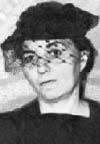 Lee's spirit and energy sustained her until the end of her life. She was constantly in flight, appearing as a delegate
at conferences all over the world. When she retired from the State Department in February 1965, she still had
ambitious plans. At her retirement ceremony she said: "I expect to be just as active in inter-American affairs as I was
previously. Now I will have more opportunity and time to devote to my special interests
— hemisphere relations — from a personal angle." She also planned to use her new leisure to pursue literary projects,
especially poetry: "You must have
leisure to write poetry; time to dream and to think," she said. With her characteristic vigor, she looked forward to
returning to Puerto Rico, her legal residence for the past forty-odd years, and where her two children and seven
grandchildren lived. She owned a beautiful home there, in Old San Juan, overlooking the bay.
Lee's spirit and energy sustained her until the end of her life. She was constantly in flight, appearing as a delegate
at conferences all over the world. When she retired from the State Department in February 1965, she still had
ambitious plans. At her retirement ceremony she said: "I expect to be just as active in inter-American affairs as I was
previously. Now I will have more opportunity and time to devote to my special interests
— hemisphere relations — from a personal angle." She also planned to use her new leisure to pursue literary projects,
especially poetry: "You must have
leisure to write poetry; time to dream and to think," she said. With her characteristic vigor, she looked forward to
returning to Puerto Rico, her legal residence for the past forty-odd years, and where her two children and seven
grandchildren lived. She owned a beautiful home there, in Old San Juan, overlooking the bay.
One of the oldest houses in Puerto Rico, Lee's home — located at 2 Calle del Sol —
had originally been the residence of conquistador-colonizer Juan Ponce de León, the first
Spanish governor of the island, then called Borinquén. With retirement in mind, Lee purchased it in
1958, and oversaw its restoration that brought back the beauty of its centuries-old colonial architecture.
She had made it a sanctuary of her own, filling it with her collection of books and paintings and
memorabilia from her travels of the world. Among her antique furniture, mostly Spanish in style,
was a maple folding-top desk from the old schoolhouse of Raymond, Mississippi.
 But just two weeks after her return to Puerto Rico, Lee was admitted to the Mimiya Clinic in San Juan: the recently diagnosed cancer in her lungs (secondary to
breast cancer treated in the late 1950s) was taking its toll.
And without ever leaving the hospital, she died peacefully there —
on April 3, 1965 —
surrounded by the "flame-trees and tree-ferns and frail white
orchises" that she had celebrated in her poem, "Rich Port." In keeping with her wishes for a prompt
burial, a funeral
service (closed casket at her request) was held for her that day in the afternoon, and she was buried in the old cemetery
by the sea, not far from her home.
But just two weeks after her return to Puerto Rico, Lee was admitted to the Mimiya Clinic in San Juan: the recently diagnosed cancer in her lungs (secondary to
breast cancer treated in the late 1950s) was taking its toll.
And without ever leaving the hospital, she died peacefully there —
on April 3, 1965 —
surrounded by the "flame-trees and tree-ferns and frail white
orchises" that she had celebrated in her poem, "Rich Port." In keeping with her wishes for a prompt
burial, a funeral
service (closed casket at her request) was held for her that day in the afternoon, and she was buried in the old cemetery
by the sea, not far from her home.
The next day her obituary appeared in the New York Times
which acknowledged her achievements as a "poet, author, translator
and lecturer" whose "works were published throughout North and
South America"; her activism as an "enthusiastic advocate" of
women's rights and "exporter" of this cause; and her public
service as the "cultural coordinator in the Office of Public
Affairs of the State Department's Bureau of Inter-American
Affairs." Hers was the lead obituary in the Washington Post:
Muna Lee, 70; Poet,
U.S. Cultural Official
The article highlighted her career in the State Department,
her contribution to Puerto Rico's political progress, her poetry
and other literary work, and her political activity with the NWP.
Also on April 4th, the New York Herald Tribune published
the most intimate and informed obituary, which was written by one
of Lee's friends who worked for the newspaper. It was that day's
lead obituary, but unlike the obituaries in the Post and
Times, it provided a vivid picture of Lee as a poet, opening
with an account of her literary beginnings:
Muna Lee's first published work
was exactly three lines in the old Smart Set magazine in
1914 [sic]. She thought she had written a poem, but to her amazement the
late Edward J. O'Brien double-starred it in his Best Short
Stories of 1915.
The lines that launched a writing career and either confused or
bemused the great student of the American short story were:
THE VIGIL
By Muna Lee
His gaze a strained attention, he stood in the door of the mad-house.
"How are you today, Charley?" asked the doctor:
And he said, "I shall know her when she
comes." |
Miss Lee proved, however, that she was a poet in the same year
the anthology containing her three lines was published. She
was awarded the Lyric Prize by Poetry
magazine. |
The rest of this article reviewed Lee's life and multi-faceted career, with
emphasis on her work for the NWP during the early years of the
Depression, when she championed the policy of non-discrimination
against women workers.
Two days after her death, the executive secretary of the
Inter-American Commission of Women, Esther de Calvo, sent a condolence letter to
Secretary of State Dean Rusk, in which she told him:
On behalf of the Inter-American
Commission of Women, and in a most personal way, I wish to express
to you, Sir, our profound sorrow at the death of Miss Muna Lee, who
was for so many years a beloved and dedicated figure in the service
of the Government of the United States. Her passing is motive of
especial regret to the Inter-American Commission of Women, of which
she was a founding member and which, for thirty-seven years, was
beneficiary of her wise and sympathetic counsel. After her recent
retirement […] her continuance in the position of Alternate
Delegate of the United States was a particular privilege and source
of strength for the Commission. Her loss is, therefore, all the
more keenly felt.
Miss Lee elicited not only
the devotion of her friends and
colleagues throughout the United States but the unanimous regard
and affection of her multitude of friends and co-workers in Latin
America. |

Soon after Lee passed away, a close friend and colleague of hers, poet Ernest Kroll, who was a
Japanese affairs specialist in the State Department during her
tenure there, wrote a eulogy titled "Muna Lee
(1895–1965)," which celebrates her remarkable vitality:
The last we saw of you, you
tossed your head
Like F.D.R. while reading verse that stirred
A murmuring of friends, who said good-bye
And sent you off to your Caribbean
Elysium, the crossbeamed house that once
Roofed over the youth-struck Ponce de León.
And then we heard you had seen the raven
Hover over your life with downward eyes,
Keeping the secret even as we thought
You winged for good to step from cloudless skies;
And, realizing you had changed direction
Quite in mid-air, slipping an earthly haven to
Dare your spirit slip right into heaven,
We thought how like you to save this last
surprise.
~~~~~~~~~~~~~
|
Muna Lee's enduring contributions to American literature and society
have sadly been forgotten, obscured by the dust cloud made by the generations
of writers and social
activists who followed in her footsteps.
Her belief in a common New World character has been eclipsed by increasing criticism of its assumptions.
Her glory days were of
another time (like the taste for her love songs), but not so
distant from the turn of the present century. She left us a
compelling body of widely varied writing replete with lyricism,
brilliance, and progressive ideas. Moreover, she expanded the
bounds of our own national literature, as part of her legacy, by
rendering in English the voices of more than sixty different poets
from Latin America, many of whom had not been known in the North
until she gave them to us. In order for us to fully appreciate our
literary and social traditions, especially with regard to poetry
and women's rights, we must come to terms with what she — and
other forgotten leaders like her — did to advance them; for she
was one of the great Pan-American pioneers, who dedicated her life
to finding our common ground with our sister republics, and
bringing the diverse peoples of the Americas together, through
literature, social change, and cultural relations.
Ultimately, the extraordinary Muna Lee was not Mississippian,
Oklahoman, or Puerto Rican, not simply North or South American,
Latin or Anglo American, but uniquely American in the original sense of the
word, which implies the Pan-Americanism that defined her.

– Note from Francis Klafter née Lee: My Sister Was a Loving Person –
– Bibliography of the Works of Muna Lee –
Copyright © 2000, 2004 by Jonathan Cohen / All rights reserved.