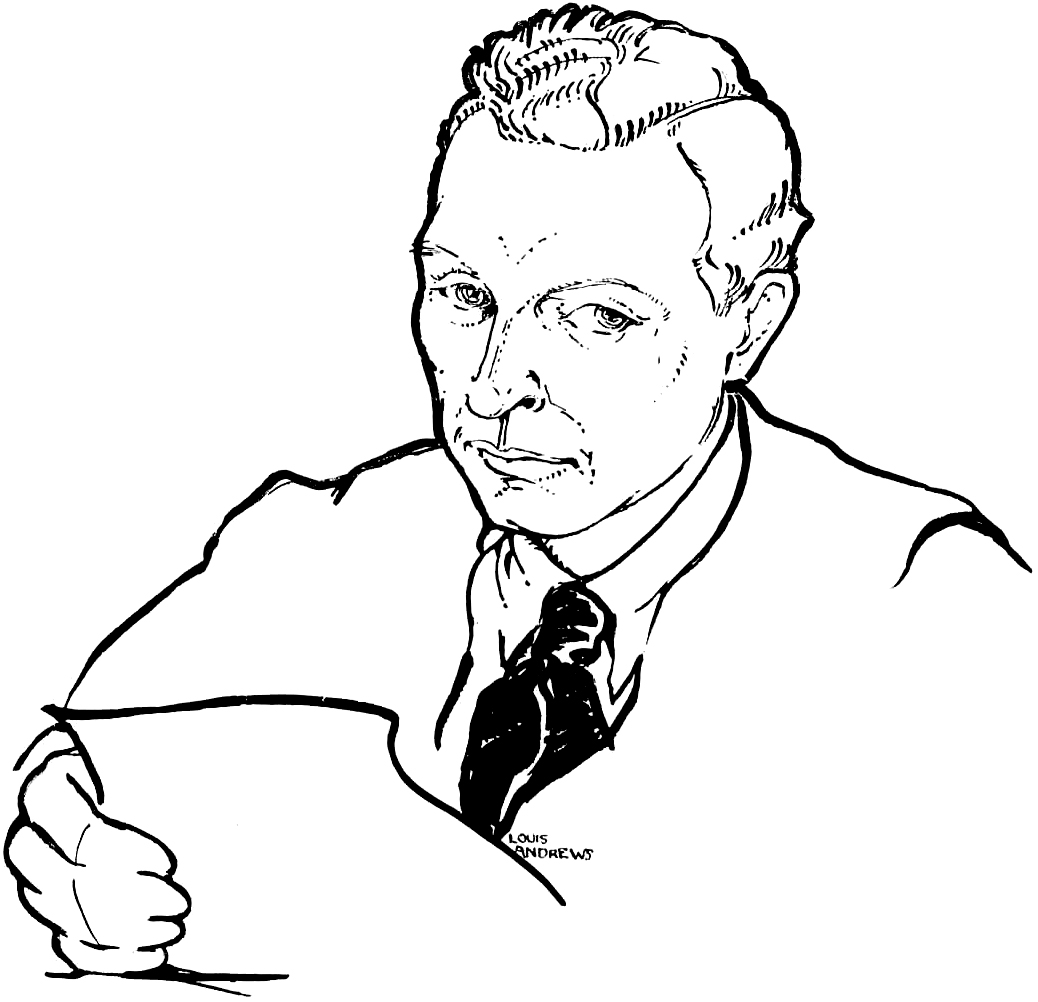
 Born in Ardmore, Oklahoma, John Peebles McClure (1893–1956) entered the University of Oklahoma in 1911 and received his BA in 1915. He had spent the year 1913–14 abroad, studying in
Paris. After his graduation, he worked as assistant librarian at the University of Oklahoma
for three years. In 1918, he got married, and also was drafted into the army. During that year, Knopf published a collection of his verse,
Airs and Ballads, as well as a collection of drinking songs, The Stag's Hornbook, which he edited (an expanded edition to which war poems were added, co-edited with William Rose Benιt, appeared in 1943).
He served in the 304th Cavalry in the First World War. After his discharge, he and his wife settled in New Orleans, where they operated a bookstore for six years.
Born in Ardmore, Oklahoma, John Peebles McClure (1893–1956) entered the University of Oklahoma in 1911 and received his BA in 1915. He had spent the year 1913–14 abroad, studying in
Paris. After his graduation, he worked as assistant librarian at the University of Oklahoma
for three years. In 1918, he got married, and also was drafted into the army. During that year, Knopf published a collection of his verse,
Airs and Ballads, as well as a collection of drinking songs, The Stag's Hornbook, which he edited (an expanded edition to which war poems were added, co-edited with William Rose Benιt, appeared in 1943).
He served in the 304th Cavalry in the First World War. After his discharge, he and his wife settled in New Orleans, where they operated a bookstore for six years.
H. L. Mencken thought very highly of McClure and, in 1919, said he was the finest "lyric poet the United States has produced in fifty years." He was, for a short while, associate editor of The Southerner: A Magazine of the New South (four issues published in New Orleans between December 1919 and May 1920). In 1921, he joined the staff of the New Orleans Times-Picayune, for which he worked until his retirement, first as copyreader, then editor of the Sunday book page, city editor, and finally head copyreader. From 1921 to 1926, he was associate editor of The Double Dealer, a literary magazine to which Lee contributed one poem and two book reviews.
STARING toward the ceiling through the darkness, she smiled to herself to realize that she could not sleep. Such nights had come to her many times; they did not trouble her; she lacked imagination to gild dull moments, but had a vivid visual memory that recalled whatever experience she wished, enabling her to feel its every emotion with undiminished poignance. Deliberately she withheld the experience she desired, that it might be the more delightful for the delay. Her mind slipped back easily …
He [McClure] was eighteen and a poet. She [Lee] was seventeen. They walked past the ugly red brick of the University buildings, climbed a barbed-wire fence with some damage to her skirt, and emerged on a country road. Infinitesimal blue daisies were just beginning to show at the roots of the dead grasses. The damp wind blew straight toward them. He took off his cap and lifted his thin face to the dampness. They walked along in silence until they had climbed a little hill and found the limestone ledge crowning its summit. "Your poems?" she asked, breathless with the strangeness of talking with a poet. He drew a freshly-copied manuscript from his pocket, and gave it to her to read. (She smiled suddenly, remembering this detail.) As she read, he slipped his arm about her with brusque awkwardness, and she leaned her head against his shoulder, deliciously aware of the roughness of his coat beneath her cheek. Shy of the inevitable kiss, they remained in tense consciousness of one another. The wind played with their hair. — Muna Lee in "The Embarkation to Cytherea." Smart Set 68.4 (Aug. 1922): 127–30. Between 1914 and 1923, Smart Set published more poems by McClure than by any other author; Lee was its second-most-frequent contributor of verse during this period. His verse appears together with hers — on the same page — in Signature of the Sun: Southwest Verse, 1900–1950 (U of New Mexico P, 1950). See more about McClure as a poet; also, see Fred Hobson's "Mencken's 'Poet Born': John McClure of Oklahoma," Menckeniana 75 (Fall 1980): 40-3.  McClure's personal relationship with William Faulkner was remarkable, as was Lee's relationship with him that came about some thirty years later. In January 1925, Faulkner traveled to New Orleans ostensibly to become acquainted with Sherwood Anderson and to wait for a ship to Europe that would exchange work for passage. He did indeed become friends with Anderson, but, in addition, he met McClure, whose Double Dealer had already published one of his poems — his first published work — and which was active in promoting the work of the "up-and-coming" writers such as Ernest Hemingway, Robert Penn Warren, and Thornton Wilder. The Double Dealer, in fact, is said to have been created in response to Mencken's criticism of the South as a cultural wasteland ("The Sahara of the Bozart," New York Evening Mail, Nov. 13, 1917). The month Faulkner arrived in New Orleans, McClure's review of his first book, The Marble Faun, a volume of poetry, appeared in the Times-Picayune (Jan. 25, 1925), and was most likely the first review ever written on him.
McClure's friendship with Faulkner led to acceptance by the Times-Picayune of his sketch titled "The Mirror of Chartres Street," which developed into a series of essays based on observation of the local scene. The sixteen stories and sketches were published in the Sunday feature section between February and September, 1925.
|